Mobile Commerce Trends 2026: Why Your Store Needs a Mobile App

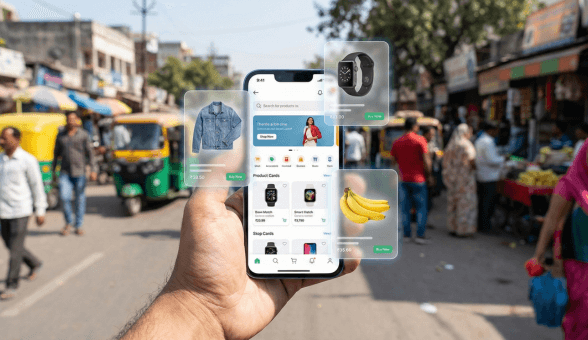
India’s e-commerce story is being written on mobile screens. Not desktops. Not laptops. Smartphones. Over 78% of all online shopping in India now happens on mobile devices, and that number keeps climbing every single quarter. In tier 2 and tier 3 cities, where the next 300 million online shoppers are coming from, mobile is not just the primary channel. It is often the only channel. For millions of Indian consumers, their smartphone is their first computer, their first internet connection, and their first shopping experience.
Yet a surprising number of Indian online sellers still operate without a dedicated mobile app. They rely on a responsive website, hoping it is good enough to capture mobile shoppers. In 2026, that gap between having an app and not having one has become a measurable business disadvantage. Stores with native mobile apps consistently see higher conversion rates, larger order values, better retention, and dramatically lower marketing costs for repeat customers.
This guide covers the mobile commerce trends shaping Indian e-commerce in 2026, explains why a mobile app is no longer optional for serious online sellers, and shows how platforms like Boomimart make it possible to launch your own branded Android and iOS app without the six-figure development costs that used to put mobile apps out of reach for small businesses.
Mobile App vs Mobile Website vs Desktop: The Numbers That Matter
Before diving into trends, let us establish why the channel your customers use matters so much. The performance gap between a native mobile app, a mobile-responsive website, and a desktop website is not marginal. It is dramatic:
| Factor | Native Mobile App | Mobile Website (Responsive) | Desktop Website |
| Share of Indian E-commerce Traffic (2026) | 55% to 60% | 20% to 25% | 15% to 20% |
| Conversion Rate (Industry Average) | 3x higher than mobile web | 1x (baseline) | 1.5x to 2x higher than mobile web |
| Average Order Value | Highest (easy reorder, saved preferences) | Lowest (friction at checkout) | Moderate (larger screen, easier browsing) |
| Page Load Speed | Instant (content cached locally) | 2 to 5 seconds (server dependent) | 1 to 3 seconds (better connections) |
| Push Notifications | Yes (direct, free, high open rates 40% to 60%) | No (only email/SMS, paid, lower open rates) | No |
| Offline Access | Partial (cached catalog, browsing) | None (requires internet) | None |
| Customer Retention | Highest (app icon on home screen is a constant reminder) | Low (customers forget the URL) | Low (depends on bookmarks/email) |
| Repeat Purchase Rate | 3x to 5x higher than mobile web | 1x (baseline) | 1.5x to 2x |
| Checkout Speed | Fastest (saved payment, addresses, one-tap order) | Slow (form filling, redirects) | Moderate |
| Camera/GPS/Sensor Access | Full native access (barcode scan, AR try-on, location) | Limited (browser APIs only) | Very limited |
| Development Cost | Rs 5 lakh to Rs 25 lakh (custom) or included with Boomimart | Rs 0 to Rs 5 lakh (responsive design) | Included with web store |
| Ongoing Maintenance | App store updates, OS compatibility | Minimal | Minimal |
| Best Use Case | Primary sales channel for serious e-commerce | Discovery and first-time visitors | B2B buyers and research-heavy purchases |
The data is clear. Native mobile apps outperform mobile websites on virtually every metric that drives e-commerce profitability. The app’s permanent presence on the customer’s home screen, combined with push notifications and saved preferences, creates a retention flywheel that mobile websites simply cannot replicate. For a detailed comparison of how Boomimart compares to other platforms on mobile commerce capabilities, our platform comparison guides break down the differences.
8 Mobile Commerce Trends Reshaping Indian E-commerce in 2026
The mobile commerce landscape is evolving rapidly. Here are the trends that every Indian online seller needs to understand and prepare for:
| Trend | What Is Happening | Impact on Indian E-commerce | How to Prepare |
| Voice Commerce | Shoppers using voice assistants to search and order products | Growing fast in regional language markets; Hindi and Tamil voice search rising sharply | Optimize product titles for conversational queries; add regional language support |
| Social Commerce Integration | Buying directly through Instagram, WhatsApp, and YouTube | India’s social commerce market expected to reach $80 billion+ by 2030 | Integrate your store with WhatsApp catalog and social sharing features |
| AR/VR Try-Before-Buy | Augmented reality letting customers visualize products before purchase | Fashion, furniture, and cosmetics categories leading adoption | Invest in 360-degree product photography; prepare for AR plugin integration |
| One-Tap Checkout | Reducing checkout to a single tap with saved payments and addresses | UPI autopay and tokenized cards making frictionless payments mainstream | Enable saved payment methods; integrate UPI autopay; minimize checkout steps |
| Hyper-Personalization via AI | AI engines showing each customer a uniquely tailored product feed | Conversion rates improving 30% to 50% with personalized recommendations | Use CRM data for customer segmentation; implement recommendation widgets |
| Progressive Web Apps (PWA) | Web apps that feel like native apps without app store installation | Bridging the gap for customers who resist downloading new apps | Ensure your mobile web meets PWA standards as a complementary channel |
| Vernacular Commerce | Shopping experiences in local Indian languages beyond English and Hindi | Tier 2 and Tier 3 cities driving next wave of e-commerce growth | Add regional language support for product listings, checkout, and customer service |
| Quick Commerce Expectations | Customers expecting delivery within 10 to 30 minutes for everyday items | Reshaping customer expectations around delivery speed | Optimize inventory for fast fulfilment; partner with hyperlocal delivery services |
Each of these trends amplifies the advantage of having a native mobile app. Voice search, AR try-on, one-tap checkout, and hyper-personalization all work significantly better within a native app environment than through a mobile browser. Sellers who invest in their mobile app presence now are positioning themselves to ride each of these waves as they mature.
For a deeper look at how AI and emerging technologies are transforming customer interactions, our guide on AI chatbots for customer support explores the conversational commerce angle, and our analysis of emerging online shopping trends covers the broader e-commerce technology landscape.
Go Mobile-First. Launch Your Branded App with Boomimart Today!
The Business Impact: Store With App vs Store Without App
Numbers speak louder than trends. Here is what the data shows when you compare the actual business metrics of e-commerce stores operating with and without a dedicated mobile app:
| Business Metric | Store Without Mobile App | Store With Mobile App (Boomimart) | Improvement |
| Monthly Repeat Customers | 8% to 12% of total customers | 25% to 40% of total customers | 3x to 4x increase in retention |
| Average Session Duration | 1.5 to 2 minutes | 4 to 7 minutes | 2x to 3x longer browsing |
| Push Notification Open Rate | N/A (email: 15% to 20%) | 40% to 60% open rate | 3x to 4x better reach than email |
| Cart Abandonment Rate | 70% to 80% | 40% to 55% | 25% to 35% reduction |
| Checkout Completion Time | 3 to 5 minutes (form filling) | 30 seconds to 1 minute (saved data) | 5x to 10x faster checkout |
| Customer Lifetime Value | Rs 500 to Rs 2,000 (1 to 2 orders) | Rs 2,000 to Rs 8,000 (5 to 10+ orders) | 3x to 5x higher CLV |
| Marketing Cost per Conversion | Rs 150 to Rs 500 (paid ads each time) | Rs 0 per push notification (free re-engagement) | Near-zero cost for repeat orders |
| Customer Data Richness | Basic (name, email, purchase history) | Deep (browsing patterns, wishlists, location, app usage) | Significantly richer insights |
The most striking number in this comparison is the marketing cost difference. For a store relying solely on a website, every repeat purchase requires paid advertising or email marketing to bring the customer back. With a mobile app, a push notification costs virtually nothing and reaches the customer directly on their home screen with open rates that dwarf email. Over 12 months, this difference alone can save lakhs in marketing spend while driving significantly more revenue.
Boomimart includes native Android and iOS apps as part of its e-commerce platform. This means you get a branded mobile app with your store’s name, logo, and product catalog without hiring a development team or managing app store submissions independently. For more on how Boomimart’s complete platform reduces your technology costs, read our ERP implementation cost reduction guide.
What Makes a Great E-commerce Mobile App in 2026
Not all mobile apps are created equal. A poorly designed app can actually hurt your brand more than having no app at all. Here are the features and design principles that separate high-performing e-commerce apps from the ones customers uninstall within a week:
Speed and Performance
- Sub-2-second load times. Every additional second of load time reduces conversions by 7% to 10%. Your app needs to feel instant. Product images should load progressively, and catalog browsing should feel smooth even on mid-range smartphones common in India.
- Lightweight app size. Indian customers are extremely conscious of phone storage. An app that takes up 200 MB will be uninstalled to make room. Keep your app under 50 MB for the best install retention rates.
- Offline catalog browsing. In many parts of India, internet connectivity is intermittent. Caching product catalogs locally so customers can browse even without connectivity prevents lost browsing sessions and keeps engagement high.
Checkout and Payments
- Saved addresses and payment methods. Every field a returning customer has to fill is a point where they might abandon the purchase. Saved data turns a 3-minute checkout into a 30-second order.
- UPI integration with intent flow. UPI is India’s dominant digital payment method. Your app should support UPI intent flow (opening the customer’s UPI app directly) rather than requiring manual VPA entry. For more on payment optimization, see our guide on Indian payment gateway providers.
- COD with smart nudges towards prepaid. Cash on delivery remains important in India, but prepaid orders reduce RTO (return to origin) rates significantly. Your app should offer COD while gently nudging customers towards prepaid with small discounts or faster delivery promises. Our guide on enhancing prepaid orders and reducing COD complexity covers proven strategies.
Engagement and Retention Features
- Smart push notifications. Not spam. Relevant, timely notifications: abandoned cart reminders, price drops on wishlisted items, order status updates, and personalized deals based on browsing history. Over-notifying is the fastest way to get uninstalled.
- Wishlist and save-for-later. Let customers bookmark products without adding to cart. Wishlists are powerful data for personalization and for triggering price-drop notifications that drive conversions.
- In-app customer support. Integrated chat, WhatsApp, or support ticket system within the app. Customers should never have to leave the app to get help.
- Loyalty and rewards integration. Points, tier-based rewards, or cashback on repeat purchases. Loyalty programs work dramatically better within an app because the points balance is always visible and top-of-mind.
Go Mobile-First. Launch Your Branded App with Boomimart Today!
Mobile Commerce Mistakes Indian Sellers Make in 2026
- Treating the mobile website as ‘good enough.’ A responsive website is a minimum requirement, not a mobile strategy. The conversion and retention gap between mobile web and native app is too large to ignore if you are serious about growth.
- Building a custom app from scratch. Unless you are a funded startup with a dedicated development team, building a custom mobile app is expensive (Rs 10 to Rs 25 lakh), slow (4 to 6 months), and creates an ongoing maintenance burden. Platforms like Boomimart that include branded apps eliminate this entire cost and complexity.
- Ignoring app store optimization (ASO). Your app needs to be discoverable in Google Play and Apple App Store. Invest in keyword-rich titles, compelling screenshots, and genuine customer reviews.
- Sending too many push notifications. Three to five well-targeted notifications per week is optimal. More than one per day and your uninstall rate will spike. Quality and relevance matter more than frequency.
- Not tracking mobile-specific analytics. Desktop and mobile users behave differently. Track mobile-specific metrics: app open rates, session length, screen-by-screen drop-off, push notification performance, and in-app search queries. Our data layer tracking guide covers the analytics fundamentals.
- Designing for desktop first, mobile second. In India, design mobile-first. Your primary product images, descriptions, category layouts, and checkout flow should be optimized for a 5 to 6 inch screen first and scaled up for desktop second.
- Forgetting regional language support. India’s next wave of online shoppers prefers Tamil, Telugu, Hindi, Kannada, and Malayalam over English. If your app only works in English, you are excluding the fastest-growing customer segments.
How Boomimart Gives You a Mobile Commerce Advantage
Building a mobile app used to require a separate development project costing Rs 10 to Rs 25 lakh, months of development time, and ongoing maintenance headaches. Boomimart changes this equation completely by including branded mobile apps as part of your e-commerce platform. Here is what you get:
- Native Android and iOS apps with your brand name, logo, and colour scheme. Your customers download your store from Google Play and the Apple App Store, not a generic marketplace app.
- Synchronized catalog and inventory. Products, prices, stock levels, and offers update in real-time across your web store and mobile app from a single admin dashboard. No duplicate management.
- Push notification engine for abandoned cart recovery, new product alerts, flash sale announcements, and order status updates. Direct to the customer’s phone at zero cost per notification.
- Integrated payment gateways including Razorpay, PayU, UPI, and COD, all pre-configured for the Indian market with GST-compliant invoicing built in.
- WhatsApp commerce integration connecting your app, web store, and WhatsApp catalog into a unified selling ecosystem. Customers can discover on WhatsApp and complete purchases in your app seamlessly.
- ERP-grade backend with inventory management, CRM, vendor management, expense tracking, and shipping integration. Everything you need to run your e-commerce operations from one place.
For a comprehensive look at how Boomimart’s complete platform compares to building your own stack, explore our comparison guides: Shopify vs Boomimart, WooCommerce vs Boomimart, Wix vs Boomimart, and Dukaan vs Boomimart.
Your Mobile Commerce Action Plan for 2026
Whether you are launching a new online store or upgrading an existing one, here is a practical timeline to establish your mobile commerce presence:
- Week 1 to 2: Audit your current mobile experience. Open your store on a smartphone. How does it load? How many taps to checkout? How does the product catalog browse? Identify every friction point.
- Week 3: Launch your Boomimart store with mobile app. Set up your web store and branded mobile app simultaneously. Upload your catalog, configure payments, and test the complete customer journey on both channels.
- Week 4 to 6: Drive app installations. Add app download banners to your website, include download links in order confirmation emails, offer a first-order discount for app users, and promote the app on your social media channels.
- Month 2 to 3: Optimize push notification strategy. Start with abandoned cart reminders and order updates. Gradually add personalized product recommendations and flash sale alerts based on customer behaviour data.
- Month 4 onwards: Measure and iterate. Track app-specific metrics: install rate, active user rate, push notification performance, app-driven revenue percentage, and repeat purchase rate. Use this data to continuously improve your mobile experience.
Mobile commerce is not a future trend. It is the present reality of Indian e-commerce, and the gap between businesses that have a mobile app and those that do not is widening every month. With Boomimart, you get a complete e-commerce platform with branded mobile apps, and you can be live in weeks rather than months.
Request a free demo and see how Boomimart’s mobile-first approach can transform your online business.