How to Sell Food Products Online in India: FSSAI, Packaging, and Logistics

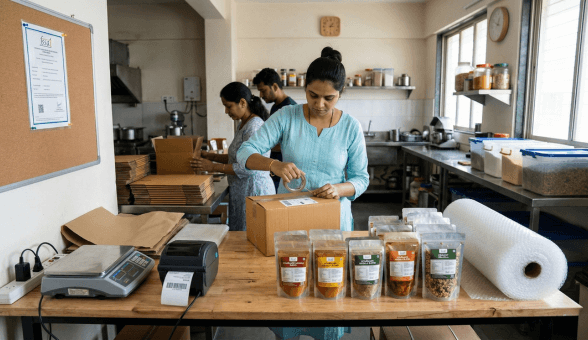
India’s online food market is one of the fastest-growing segments in e-commerce, and the opportunity extends far beyond the Swiggy and Zomato model. Home bakers selling sourdough on Instagram. Village cooperatives shipping organic pickles pan-India. Small-batch masala brands building loyal customer bases through WhatsApp. Artisan chocolate makers competing with imported brands through beautifully designed online stores. The path from kitchen to customer’s doorstep has never been shorter or more accessible.
But selling food online is not the same as selling clothes or electronics. Food is regulated. Food is perishable. Food is personal. A customer will forgive a slightly delayed T-shirt delivery, but a leaking pickle jar or a stale batch of cookies damages your brand permanently. The three pillars that determine whether your online food business thrives or struggles are compliance (getting your FSSAI and other licenses right), packaging (protecting product quality through transit), and logistics (getting fresh, intact products to customers on time).
This guide covers all three pillars in practical detail, specifically for Indian food entrepreneurs selling through their own online stores. Whether you are a home baker launching your first website, a regional food brand going pan-India, or a food manufacturer adding a direct-to-consumer channel, you will find actionable steps for every stage. And with a platform like Boomimart, you get the e-commerce infrastructure, inventory management, and shipping tools built for exactly this kind of business.
FSSAI Licensing: The Non-Negotiable First Step
You cannot legally sell food products in India, online or offline, without an FSSAI (Food Safety and Standards Authority of India) license or registration. This is not optional, and operating without it can result in fines up to Rs 5 lakh and imprisonment. Every food package must display a valid FSSAI license number. Here is how to determine which license you need:
| FSSAI License Type | Annual Turnover | Applicable Business | Registration Fee | Validity | Processing Time |
| Basic Registration | Up to Rs 12 lakh per year | Home bakers, small cottage food producers, petty food vendors, tiffin services | Rs 100 per year | 1 to 5 years | 7 to 30 days |
| State License | Rs 12 lakh to Rs 20 crore per year | Small to mid-sized food manufacturers, storage units, restaurants, caterers, online food retailers | Rs 2,000 to Rs 5,000 per year | 1 to 5 years | 30 to 60 days |
| Central License | Above Rs 20 crore per year | Large manufacturers, importers, exporters, operators in 2+ states, e-commerce food platforms with central warehouse | Rs 7,500 per year | 1 to 5 years | 30 to 60 days |
How to Apply for FSSAI Registration or License
- Step 1: Visit the FSSAI FoSCoS portal (foscos.fssai.gov.in). All applications are processed online through this single portal.
- Step 2: Select your license type based on your annual turnover and business scale as outlined in the table above. If you are starting small, Basic Registration is sufficient and can be upgraded later as your business grows.
- Step 3: Prepare your documents. For Basic Registration: identity proof, address proof, and a passport-size photo. For State and Central Licenses: add food safety management plan, layout plan of the facility, list of equipment, list of food products with their categories, and water test report.
- Step 4: Pay the fee and submit. Fees are modest. The portal generates a reference number for tracking. Basic Registration is often approved within 7 days. State and Central Licenses take 30 to 60 days and may involve a facility inspection.
- Step 5: Display your license number. Once approved, your FSSAI license number must appear on every product label, your website, and your online store. The 14-digit license number and the FSSAI logo are mandatory on all food packaging.
Beyond FSSAI: Other Licenses You May Need
- GST Registration: Mandatory if your annual turnover exceeds Rs 40 lakh (Rs 20 lakh for special category states) or if you sell interstate. Even below the threshold, voluntary GST registration enables you to claim input tax credits and sell on marketplaces. Boomimart’s built-in GST module handles tax calculation and invoice generation automatically.
- Shop and Establishment License: Required if you operate from a commercial premises. Available from your local municipal corporation. Not needed for home-based operations in most states.
- Trade License: Required by some municipal corporations for food businesses. Check your local requirements.
- Organic Certification (NPOP/PGS): If you are selling products as ‘organic,’ you must have valid certification under the National Programme for Organic Production (NPOP) or Participatory Guarantee System (PGS). Without certification, labelling products as organic is illegal.
- AGMARK (optional): Government quality certification for agricultural products like honey, ghee, and spices. Not mandatory but builds significant consumer trust.
Ready to Launch Your Food Brand Online? Talk to Our Team!
Food Packaging That Protects, Complies, and Sells
Packaging is where food e-commerce gets technically demanding. Your packaging has to accomplish three jobs simultaneously: protect the product through 2 to 7 days of transit across Indian conditions (heat, humidity, rough handling), comply with FSSAI labelling regulations, and look attractive enough to justify your premium over supermarket alternatives. Getting any one of these wrong creates problems.
FSSAI Mandatory Label Requirements
Every packaged food product sold in India must display the following information on its label. Missing any of these can result in penalties and product seizure:
- Product name and brand name
- Complete list of ingredients in descending order of quantity
- Net weight or volume
- FSSAI logo and 14-digit license number
- Name and address of the manufacturer, packer, or importer
- Manufacturing date and best before or use by date
- Batch or lot number
- Nutritional information panel (calories, protein, carbohydrates, fat, sugar, sodium per 100g)
- Allergen declaration (if product contains common allergens like gluten, dairy, nuts, soy)
- Vegetarian or non-vegetarian symbol (green dot or brown dot)
- Storage instructions
- MRP (Maximum Retail Price) including all taxes
Category-Specific Packaging Guide
Different food products need different packaging approaches. Here is a detailed reference covering the most common online food categories in India:
| Food Category | Packaging Type | Shelf Life (Approx.) | Storage Condition | Key Compliance Label Info | Shipping Consideration |
| Dry Snacks (chips, namkeen, murukku) | Nitrogen-flushed pouches, metalized film | 3 to 6 months | Cool, dry place. Below 25 degrees C | Best before, net weight, allergens, nutritional info | Standard courier. No cold chain needed. |
| Pickles and Chutneys | Glass jars or food-grade PET jars with tamper-evident lids | 6 to 12 months | Room temperature. Away from sunlight | FSSAI logo, ingredients, oil type used, best before | Leak-proof inner packaging. Bubble wrap essential. |
| Spices and Masala Powders | Laminated stand-up pouches or airtight containers | 6 to 12 months | Cool, dry place. Away from moisture | Net weight, batch number, manufacturing date, best before | Standard courier. Moisture barrier packaging critical. |
| Baked Goods (cookies, cakes, bread) | Food-grade boxes, vacuum-sealed for longer shelf life | 3 days to 3 months (varies widely) | Room temp for cookies. Refrigerated for cream-based items | Allergens (gluten, dairy, nuts), best before, storage instructions | Fragile handling. Air cushion packaging for protection. |
| Honey, Jams, and Spreads | Glass jars or HDPE food-grade containers | 12 to 24 months | Room temperature. Away from direct heat | Net weight, FSSAI, sugar content, best before | Leak-proof wrapping. Double boxing for glass jars. |
| Ready-to-Eat Meals (frozen) | Vacuum-sealed trays, modified atmosphere packaging | 1 to 6 months (frozen) | Frozen: minus 18 degrees C. Refrigerated: 2 to 4 degrees C | Heating instructions, allergens, nutritional info, use by date | Cold chain mandatory. Insulated boxes with gel packs. |
| Dry Fruits and Nuts | Vacuum-sealed pouches or resealable zip-lock bags | 6 to 12 months | Cool, dry place. Refrigerate after opening | Net weight, country of origin, best before, allergens (tree nuts) | Standard courier. Crush-proof outer packaging. |
| Organic and Health Foods (millet flour, protein bars) | Stand-up kraft pouches or eco-friendly packaging | 3 to 12 months | Cool, dry place | Organic certification mark, FSSAI, nutritional claims verification | Standard courier. Highlight organic certification on package. |
| Beverages (juices, syrups, cold-pressed) | Glass bottles, food-grade PET, tetra packs | 3 days to 6 months (varies) | Refrigerated for fresh. Room temp for processed | Fruit content %, preservatives used, best before, storage | Cold chain for fresh juices. Leak-proof and shatter-resistant packaging. |
| Chocolates and Confectionery | Food-grade boxes with aluminium foil wrap, insulated packaging | 3 to 12 months | Below 20 degrees C. Away from humidity | Cocoa content, allergens, best before, vegetarian mark | Summer: cold chain or gel packs mandatory. Fragile handling. |
Packaging Design Tips That Boost Sales
- Invest in professional label design. In a crowded online marketplace, your packaging is your storefront. A well-designed label with clean typography, appetizing imagery, and clear brand identity justifies premium pricing and builds trust instantly.
- Use eco-friendly packaging where possible. Indian consumers, especially in the premium and organic food segments, increasingly prefer brands that minimize plastic. Kraft paper, compostable pouches, and glass jars communicate quality and environmental responsibility.
- Include a QR code linking to your store. Print a QR code on your packaging that links to your Boomimart store or a specific reorder page. Customers who enjoy your product can reorder in seconds by scanning the package.
- Double-layer your transit packaging. The inner packaging (your branded product package) should be wrapped inside an outer transit package with appropriate cushioning. Food products need more protection than typical e-commerce items because damage is not just cosmetic; it can make the product unusable.
For more guidance on how product presentation impacts online sales, our guide on design and development techniques to improve your product page covers the digital side of presenting food products attractively.
Ready to Launch Your Food Brand Online? Talk to Our Team!
Food Logistics: Getting Fresh Products to Customers Intact
Logistics is the make-or-break factor for online food businesses. A beautiful website and compliant packaging mean nothing if the product arrives damaged, stale, or spoiled. Indian logistics presents unique challenges for food: extreme summer temperatures (40 degrees C+ in many regions), monsoon humidity, rough handling during transit, and long delivery timelines to tier 2 and tier 3 cities.
Choosing the Right Delivery Partner
Your delivery partner choice depends on your product type (perishable vs shelf-stable), delivery geography (local vs pan-India), and budget. Here is how the major options compare for food e-commerce:
| Delivery Partner | Best For | Cold Chain Support | COD Available | Approx. Cost (per kg, metro) | Serviceable Pincodes |
| Delhivery | Pan-India standard and express shipments | Yes (through Delhivery Fresh) | Yes | Rs 50 to Rs 80 | 18,000+ |
| Ecom Express | COD-heavy food businesses with returns management | Limited | Yes (strong COD network) | Rs 45 to Rs 75 | 15,000+ |
| BlueDart | Premium and time-sensitive food deliveries | Yes (temperature-controlled) | Yes | Rs 80 to Rs 120 | 12,000+ |
| Dunzo / Swiggy Genie | Hyperlocal same-day food delivery within city | Not dedicated (fast transit compensates) | Yes | Rs 30 to Rs 60 (distance-based) | Metro cities only |
| DTDC | Budget-friendly shipments for shelf-stable foods | No | Yes | Rs 40 to Rs 65 | 10,000+ |
| India Post (Speed Post) | Remote and rural area delivery for non-perishable foods | No | Yes (VPP) | Rs 30 to Rs 50 | 25,000+ (widest reach) |
| Shadowfax | Quick commerce and hyperlocal food delivery | Limited | Yes | Rs 35 to Rs 55 | 8,000+ |
| Self-Delivery (own riders) | High-volume local delivery with full quality control | You control it (insulated bags) | Yes | Rs 15 to Rs 35 (own cost structure) | Your delivery radius |
For shelf-stable products like dry snacks, spices, pickles, and packaged foods, standard courier partners work fine with proper packaging. For perishable items like baked goods, fresh juices, dairy products, or frozen meals, you need either cold chain logistics or hyperlocal delivery with fast transit times. For a deeper look at optimizing your shipping operations, our comprehensive guide on shipping management hacks for Indian SMBs covers partner selection, rate negotiation, and tracking setup.
Managing Perishable Inventory
Food inventory management is fundamentally different from general e-commerce because your products have an expiry date. Every unit on your shelf is losing value by the day. Here are the principles that prevent waste and protect your margins:
- FIFO is mandatory (First In, First Out). Always ship the oldest stock first. Your inventory management system must enforce FIFO at the pick-and-pack level, not just at the accounting level.
- Set minimum shelf life rules for shipping. Never ship a product with less than 60% to 70% of its shelf life remaining. A customer receiving cookies that expire in 2 weeks when the original shelf life was 3 months will feel cheated.
- Produce in small batches initially. Overproduction is the number one margin killer for food startups. Start with batch sizes that you can sell within 50% of the shelf life. Scale production only after demand patterns are established.
- Track expiry dates at the SKU-batch level. Boomimart’s inventory management system lets you track stock by batch with expiry dates, ensuring you always know exactly which units to ship first and which are approaching their sell-by date. For a complete approach to inventory management, read our inventory management best practices guide.
- Plan for seasonal demand fluctuations. Festivals like Diwali, Raksha Bandhan, Holi, and Christmas drive massive spikes in food gift orders. Prepare production schedules and packaging stock 4 to 6 weeks in advance.
Setting Up Your Online Food Store on Boomimart
With your compliance, packaging, and logistics foundations in place, here is how to set up a food e-commerce store that converts:
- Step 1: Set up your Boomimart store. Create your account, choose your plan, and configure your store with your brand name, logo, colours, and domain. Boomimart gives you a web store plus native Android and iOS apps from a single setup. Request a demo to see the platform in action.
- Step 2: Configure GST and invoicing. Set up your GST details and product-level HSN codes. Food products fall under different GST slabs: 0% (unbranded staples), 5% (branded staples, sugar, tea, spices), 12% (processed foods, frozen items, fruit juices), and 18% (premium chocolates, ice cream, certain snacks). Boomimart calculates GST automatically based on your product configuration.
- Step 3: Build your product catalog. Upload appetizing product photos (our guide on product page optimization helps here). Write descriptions that emphasize ingredients, sourcing, freshness, and what makes your product special. Include weight options if applicable (250g, 500g, 1kg).
- Step 4: Set up inventory management. Configure batch tracking with expiry dates. Set reorder alerts so you never run out of bestsellers or continue selling products approaching expiry.
- Step 5: Integrate payment gateways. Enable UPI, credit/debit cards, net banking, and COD. Indian food customers, especially first-time buyers, prefer COD for trust reasons. As trust builds, nudge them towards prepaid orders with small incentives. For payment strategy, see our Indian payment gateway guide.
- Step 6: Connect your delivery partners. Integrate with your chosen courier partners through Boomimart’s shipping module. Set delivery zones, shipping rates (flat rate, weight-based, or free shipping above a threshold), and estimated delivery timelines.
- Step 7: Launch and market. Start with WhatsApp sharing to your existing network. Run targeted Instagram and Facebook ads with appetizing food photography. Enable Google Shopping listings through schema markup for organic discovery.
How Much Does It Cost to Start an Online Food Business in India?
One of the most common questions food entrepreneurs ask is about startup costs. Here is a realistic breakdown across three business scales:
| Cost Category | Home-Based / Cottage (Budget) | Small Commercial Kitchen (Mid) | Full Manufacturing Unit (Scale) | Notes |
| FSSAI License | Rs 100 to Rs 500 (Basic Registration) | Rs 2,000 to Rs 5,000/year (State License) | Rs 7,500/year (Central License) | Mandatory. Cannot sell food without it. |
| GST Registration | Free (if under Rs 40 lakh turnover, voluntary) | Free (mandatory above Rs 40 lakh) | Free (mandatory) | Required for interstate sales regardless of turnover. |
| Kitchen Setup / Equipment | Rs 10,000 to Rs 50,000 (existing kitchen + small upgrades) | Rs 1 lakh to Rs 5 lakh (commercial equipment) | Rs 10 lakh to Rs 50 lakh+ | Depends heavily on food category. |
| Packaging (initial stock) | Rs 5,000 to Rs 15,000 | Rs 20,000 to Rs 75,000 | Rs 1 lakh to Rs 5 lakh | Food-grade, FSSAI-compliant labelling included. |
| Branding and Label Design | Rs 2,000 to Rs 10,000 (freelance designer) | Rs 10,000 to Rs 30,000 | Rs 30,000 to Rs 1 lakh | Professional design pays off in customer trust. |
| E-commerce Platform | Rs 2,000 to Rs 5,000/month (Boomimart) | Rs 5,000 to Rs 10,000/month | Rs 10,000 to Rs 25,000/month | Boomimart includes web store, mobile app, ERP. |
| Product Photography | Rs 0 to Rs 2,000 (smartphone + natural light) | Rs 5,000 to Rs 15,000 (semi-pro setup) | Rs 15,000 to Rs 50,000 (professional shoot) | Critical for food. Appetizing images sell. |
| Initial Marketing | Rs 5,000 to Rs 15,000/month | Rs 15,000 to Rs 50,000/month | Rs 50,000 to Rs 2 lakh/month | Social media, Google Ads, WhatsApp marketing. |
| Delivery/Shipping Setup | Rs 0 (pay per shipment to courier partners) | Rs 5,000 to Rs 20,000 (insulated packaging stock) | Rs 50,000+ (cold chain setup) | Food needs better packaging than general e-commerce. |
| Total Year 1 Investment (Approx.) | Rs 50,000 to Rs 1.5 lakh | Rs 3 lakh to Rs 10 lakh | Rs 15 lakh to Rs 60 lakh+ | Home-based is the lowest-risk starting point. |
The home-based model is the smartest starting point for most food entrepreneurs. It keeps your risk low while you validate product-market fit. Once you have consistent orders and proven recipes, scaling to a commercial kitchen becomes a calculated investment rather than a gamble. For a broader perspective on managing e-commerce technology costs as you scale, our ERP implementation cost reduction guide offers relevant strategies.
Marketing Your Online Food Brand
Food is one of the most visual and shareable product categories, which means your marketing can be both highly effective and relatively low-cost if you approach it strategically:
- Instagram is your best friend. Food photography performs exceptionally well on Instagram. Post consistently (3 to 5 times per week), use Reels for behind-the-scenes cooking content, and leverage food-related hashtags relevant to your niche and city.
- WhatsApp for direct relationships. Build a WhatsApp broadcast list of your customers. Share new product launches, festive specials, and limited-edition batches directly. WhatsApp messages have 85% to 95% open rates compared to 15% to 20% for email.
- Customer reviews and food photos. Encourage customers to share photos of your food products on social media. User-generated content builds trust more effectively than any advertising because it shows real people enjoying your products in real settings.
- Festive and seasonal campaigns. Plan special gift boxes and festive packaging for Diwali, Christmas, Holi, Raksha Bandhan, Pongal, and Onam. Food gifting is a massive category and festivals provide natural demand spikes.
- Local SEO optimization. Many food searches are local: ‘homemade pickles in Chennai,’ ‘organic honey near me,’ ‘best masala in Hyderabad.’ Optimize your product titles and descriptions for city-specific and region-specific search terms.
- Sampling and collaboration. Send free samples to local food bloggers and micro-influencers. A single honest review from a food influencer with 10,000 engaged followers can drive more sales than Rs 50,000 in ads.
For more e-commerce marketing strategies beyond food-specific tactics, our guides on digital entrepreneurship ideas and e-commerce traffic management provide broader frameworks.
Common Mistakes That Kill Online Food Businesses
- Skipping FSSAI registration. Even if you are a home baker selling 10 cakes a month, you need at least Basic FSSAI Registration. Getting caught without it means fines, legal trouble, and destroyed customer trust.
- Underestimating Indian summer conditions. Products that survive transit in November may melt, spoil, or degrade in May. Test your packaging and product stability under extreme heat conditions (40 degrees C+) before selling pan-India.
- Pricing too low to cover packaging and shipping. Food packaging and cold chain logistics cost more than standard e-commerce. If your pricing does not account for insulated packaging, gel packs, and heavier-duty outer boxes, your margins will be negative.
- Overproducing before validating demand. Start with small batches and pre-order models. Producing 500 units of a new product before testing with 50 customers is a recipe for waste and financial loss.
- Ignoring return and refund policies for food. Food returns are complicated because products cannot be resold. Create a clear policy: full refund or replacement for damaged/spoiled items with photo proof, but no returns for taste preference. Display this prominently on your store.
- Not tracking batch-level inventory. Selling products from multiple production batches without tracking which batch shipped to which customer makes it impossible to manage recalls, quality complaints, or expiry issues. Boomimart’s batch tracking prevents this.
- Relying only on marketplace aggregators. Selling only through Amazon or Flipkart means you do not own your customer relationship, your margins are squeezed by commissions, and you are subject to their policies. Build your own store on Boomimart for brand control and data ownership, then use marketplaces as a supplementary channel.
Your Food E-commerce Launch Checklist
- Week 1 to 2: Apply for FSSAI Registration or License. Register GST if applicable. Finalize your product lineup (start with 5 to 10 products maximum).
- Week 3 to 4: Source food-grade packaging. Get label designs with all FSSAI-mandatory information. Conduct shelf life testing on your products under transit-simulated conditions.
- Week 5 to 6: Set up your Boomimart store. Upload product catalog with professional food photography. Configure inventory management with batch tracking and expiry dates. Integrate payment gateways.
- Week 7 to 8: Sign up with delivery partners. Test shipment quality by sending sample orders to friends or family in different cities. Verify that products arrive in good condition. Refine packaging based on feedback.
- Week 9+: Launch with a soft opening to your immediate network. Collect feedback, reviews, and testimonials. Begin Instagram, WhatsApp, and local SEO marketing. Scale production and marketing based on order patterns.
Selling food products online in India is one of the most rewarding e-commerce opportunities available today. The market is massive, consumer demand for quality food delivered to their doorstep is growing every year, and the barriers to entry are lower than most people assume. With the right compliance, packaging, and logistics in place, and with a platform like Boomimart handling your technology, inventory, and customer management, you can turn your recipes, your sourcing expertise, or your food brand into a thriving online business.
Request a free demo and see how Boomimart’s e-commerce ERP can power your food business from kitchen to customer.