
How to Sell Ayurvedic and Wellness Products Online in India

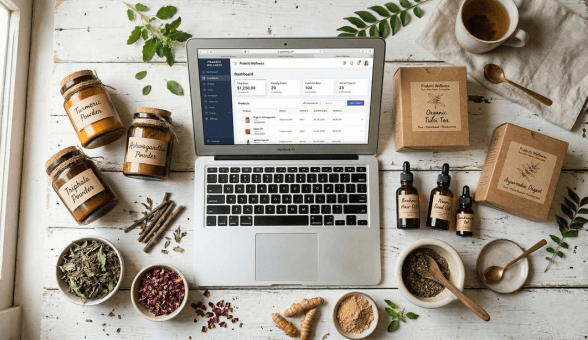
India is one of the largest and fastest-growing markets for Ayurvedic and wellness products. With a consumer base that has grown more health-conscious than ever and a government actively promoting the AYUSH sector, there has never been a better time to take your wellness brand online. Whether you are a small herbal formulator, a certified Ayurvedic practitioner with a product line, or a wellness entrepreneur looking to sell organic supplements and natural beauty products, selling online gives you access to customers across the country and even internationally.
But launching an online store for Ayurvedic and wellness products is not the same as setting up a regular e-commerce shop. There are specific licenses to obtain, labelling regulations to follow, and sourcing and certification standards that buyers today actively check before purchasing. Getting these right from the start determines whether your brand builds long-term trust or faces compliance problems that derail growth.
This guide covers everything you need to know about how to sell ayurvedic products online India as a compliant, competitive, and profitable business in 2026.
The Opportunity: Why Ayurvedic E-Commerce Is a Strong Business Play Right Now
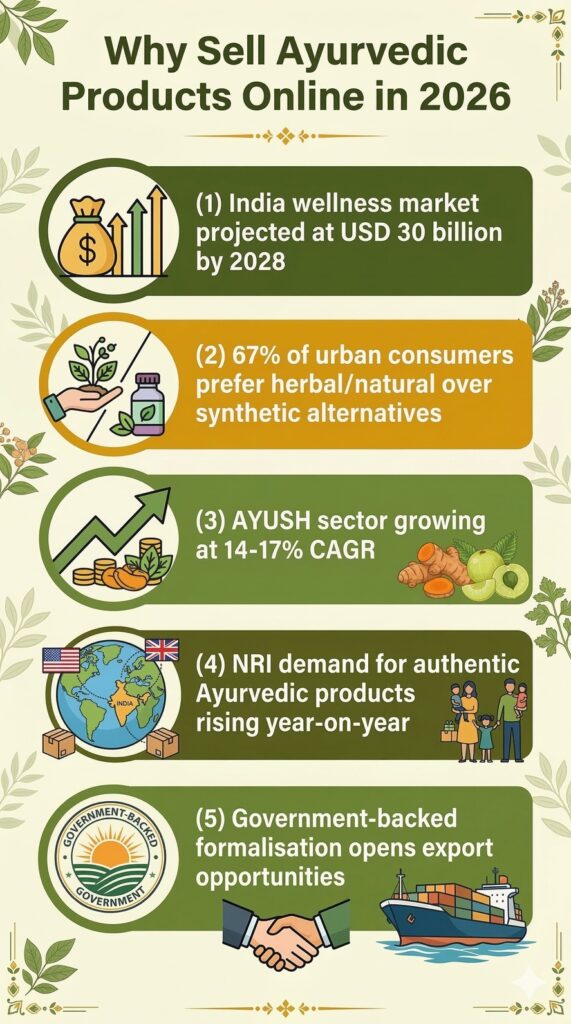
The Indian wellness market is projected to cross USD 30 billion by 2028, with Ayurvedic and herbal products accounting for a significant and growing share. Demand is being driven by urban consumers seeking natural alternatives to synthetic medicines, rural consumers continuing generational traditions, and a large NRI population outside India that actively seeks authentic Ayurvedic products.
Online channels have become the preferred way to discover and purchase these products. Consumers research ingredients, look for certifications, compare formulations, and read peer reviews before buying. This gives authentic, well-documented brands a real edge over unbranded competitors that rely on price alone.
The AYUSH Ministry has also been pushing for formalisation of the sector, which means that brands that invest in compliance today will find it far easier to scale across marketplaces and export markets tomorrow.
Understanding the Regulatory Landscape Before You Start
This is the section most wellness entrepreneurs skip, and it is the one that causes the most problems. Ayurvedic and herbal products fall under a specific regulatory framework that is different from regular food or cosmetic products.
AYUSH Licensing: Who Needs It and What It Covers
If you are manufacturing Ayurvedic, Siddha, Unani, or herbal formulations that are intended for therapeutic use, you need a license from the AYUSH Ministry under the Drugs and Cosmetics Act, 1940. The license is issued by the respective State Licensing Authority (SLA).
There are two primary categories most sellers fall into:
| License Type | Who It Applies To | Issued By |
| Manufacturing License (Form 25D) | Manufacturers of Ayurvedic/Unani/Siddha formulations | State Licensing Authority |
| Loan License | Sellers using a third-party licensed manufacturer under their brand | State Licensing Authority |
| FSSAI License | Ayurvedic health foods, herbal beverages, nutraceuticals | Food Safety and Standards Authority |
If your products are marketed as wellness or cosmetic items rather than medicines (for example, herbal face oils or wellness teas without therapeutic claims), FSSAI registration or BIS certification may apply instead of the AYUSH manufacturing license. When in doubt, consult a regulatory consultant who specialises in the wellness sector before labelling your products.
FSSAI Registration for Ayurvedic Health Foods and Nutraceuticals
Herbal teas, Ayurvedic health drinks, moringa powders, adaptogen blends, and immunity supplements that are positioned as food products need FSSAI registration or licensing depending on your annual turnover. The registration categories are:
- Basic FSSAI registration for businesses with annual turnover below INR 12 lakhs
- State FSSAI license for turnover between INR 12 lakhs and INR 20 crores
- Central FSSAI license for turnover above INR 20 crores or for online sellers serving customers across multiple states
For most wellness entrepreneurs starting out, a state FSSAI license is the practical starting point. Apply through the FoSCoS portal and keep your application documents, including your premises certificate, product list, and identity documents, ready.
Organic Certification: Building Premium Trust
If your products use organic ingredients and you want to use the word “organic” on your packaging, you need certification from an accredited agency under the National Programme for Organic Production (NPOP) administered by APEDA. For products sold domestically, PGS-India (Participatory Guarantee System) is another recognized certification pathway that is particularly accessible for smaller producers and farmer collectives.
Setting Up Your Product Catalog: What Wellness Buyers Look For
Your product catalog is where your compliance documentation and your brand storytelling must work together. Wellness consumers are more educated than ever. They read ingredient lists, check certifications, and look for manufacturing transparency.
Product Page Essentials for Ayurvedic Products
- Complete ingredient list with Sanskrit/vernacular names alongside common names
- Dosage form and method of use (tablet, powder, oil, capsule, syrup)
- AYUSH or FSSAI license number visibly displayed
- Manufacturing and expiry date format as per labelling regulations
- Net quantity and MRP inclusive of all taxes
- Name and address of the manufacturer
- Country of origin
- Batch number for traceability
Your product catalog setup should also include high-quality product photography showing the packaging, the product itself (especially for powders, oils, and loose herbs), and ideally a lifestyle image showing the product in use. Wellness buyers respond strongly to visual cues that communicate purity, natural origin, and care in formulation.
Restricted Health Claims: What You Cannot Say
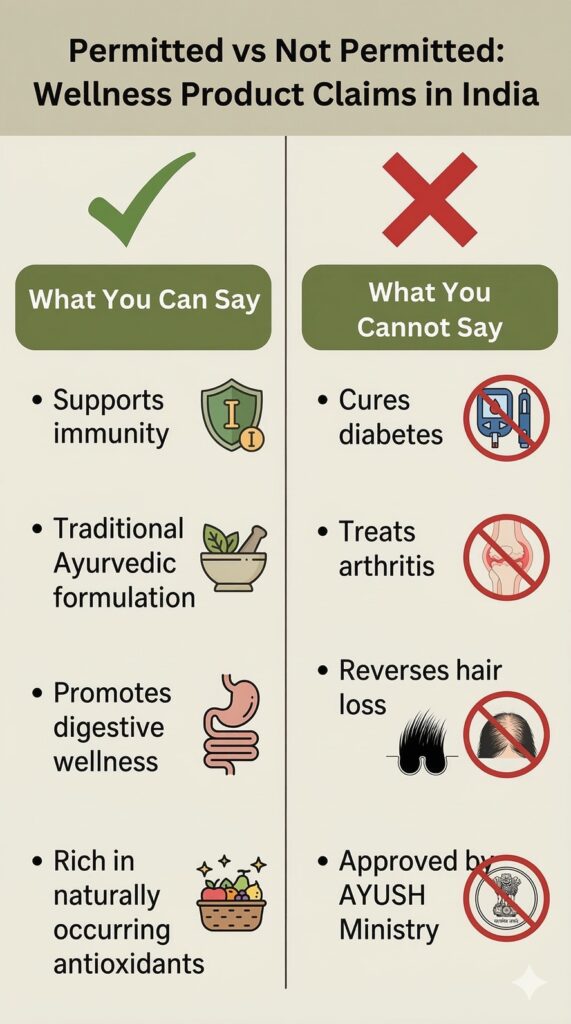
This is a critical compliance area. Under Indian regulations, you cannot make disease-specific claims on Ayurvedic products unless they are registered as medicines. Phrases like “cures diabetes”, “treats arthritis”, or “reverses hair loss” are not permitted on wellness product packaging or online store pages.
What you can communicate are general wellness benefits, traditional use claims backed by classical Ayurvedic texts, and educational content about ingredients. For example, saying that ashwagandha supports stress adaptation or that turmeric has traditionally been used for its anti-inflammatory properties is appropriate. These distinctions matter not just for compliance but also for building long-term customer trust.
Choosing the Right Platform to Sell Ayurvedic Products Online
The platform you choose determines how well you can manage compliance documentation, product variants, inventory, and customer communication as your wellness brand grows.
| Platform Type | Best For |
| Own website via hosted platform (Boomimart) | Full brand control, compliance docs, custom catalog |
| Marketplace listing (Amazon, Flipkart) | Discovery and volume at early stage |
| D2C + marketplace combined | Scaling brands with repeat purchase focus |
Building your own store on a platform like Boomimart gives you control over product descriptions, certifications display, customer data, and pricing that marketplaces simply do not allow. For wellness brands where trust and ingredient transparency are central to the buying decision, owning your storefront is not optional. It is the foundation of brand equity.
Features Your Wellness Store Must Have
- Certificate upload fields on product pages (AYUSH license, FSSAI, organic certs)
- Multi-image and video support to show packaging, labels, and product in use
- Subscription ordering for repeat-purchase products like daily supplements
- Detailed ingredient pages or ingredient glossary linking from product pages
- Customer review system with photo and video upload capability
- WhatsApp integration for wellness consultation queries before purchase
Building a Compliant and Conversion-Ready Product Page
The product page is where your compliance work and your brand story converge. A wellness buyer who reaches your product page has already expressed interest. Your job is to convert that interest into confidence and then into a purchase.
Above the Fold: What Buyers Should See First
Lead with the product name in both English and its traditional name where relevant (for example, “Ashwagandha Root Powder (Withania somnifera)”). Show the product image prominently with at least three angles: the front of the pack, the back label showing ingredients and license numbers, and a purity or sourcing visual such as the herb in its natural form.
Display trust badges prominently above the fold: AYUSH licensed, FSSAI registered, Certified Organic (if applicable), third-party tested, and Made in India. These are not decorative elements. They are decision-making triggers for health-aware buyers.
Below the Fold: Content That Educates and Converts
The content below the fold should answer every question a careful buyer might have before reaching for their wallet. Structure it as:
- About the Herb/Ingredient: origin, traditional use, classical texts it appears in
- How It Works: the bioactive components and their general wellness role (without disease claims)
- How to Use: dosage, timing, carrier (e.g., with warm milk or water), and duration
- Sourcing Story: where your ingredients are sourced, farmer partnerships, or wild-harvested certifications
- Third-Party Testing: lab reports or certificates of analysis available on request or downloadable
- FAQ Section: common questions about the product, its interaction with medications, and suitability for pregnant women or children
Logistics and Packaging for Wellness Products
Wellness products come with specific packaging and logistics requirements that differ from standard e-commerce goods.
Packaging Compliance
All primary packaging (the container the product is in) and secondary packaging (the outer box or pouch) must carry the mandatory label information as outlined earlier. For ayurvedic medicines specifically, the size of the text for ingredients and dosage is regulated. Invest in a packaging design that embeds compliance requirements within an aesthetically appealing design rather than treating them as an afterthought.
Storage and Temperature Sensitivity
Many Ayurvedic oils, herbal syrups, and fresh-herb products have storage requirements. If your product needs refrigeration during transit or is sensitive to humidity, you need to factor this into your fulfilment setup. During Indian summers, temperature-sensitive products that are shipped without appropriate insulation can degrade, triggering customer complaints and returns.
Tamper-Evident Seals and Lot Tracking
Wellness buyers are wary of tamper-evident packaging because they are consuming or applying the product on their bodies. Tamper-evident seals, induction seals on bottles, and inner packaging that makes tampering visible build trust and reduce return rates. Lot number tracking also allows you to manage quality incidents quickly if a batch has an issue.
| Packaging Type | Best For |
| Amber glass bottles with dropper | Herbal oils, tinctures, essential oils |
| Kraft paper stand-up pouches | Herbal teas, powders, seeds |
| Dark HDPE containers | Herbal capsules, churnas, tablets |
| Induction-sealed glass jars | Herbal ghee, lehyam, jams, pastes |
Digital Marketing Strategies That Work for Ayurvedic Brands
Wellness is one of the most content-rich niches in e-commerce. Buyers research extensively before purchasing, which means brands that consistently produce trustworthy, educational content capture intent at every stage of the buyer journey.
SEO Content Strategy
Build a content library around ingredient knowledge, wellness conditions (with informational framing, not disease treatment), and traditional Ayurvedic practices. Articles like “What is Shatavari and who should take it”, “Differences between Ashwagandha KSM-66 and standard root powder”, and “How to use Triphala in your daily routine” attract highly qualified buyers. Link these articles to your product pages. For guidance on how to structure product-led content for organic traffic, the insights in this content marketing framework for e-commerce are worth reviewing.
Instagram and YouTube for Trust Building
Short-form video content that shows your manufacturing process, ingredient sourcing visits, and formulation expertise builds enormous trust for wellness brands. Authenticity is the currency of wellness marketing. A 60-second video of your herbalist discussing why a specific sourcing region matters for turmeric quality will outperform a polished product advertisement every time.
Use Instagram to showcase your packaging, behind-the-scenes process content, and customer testimonials. YouTube is the platform to go deep on ingredient education. The combination of these two platforms with a well-optimised product catalog creates a discovery-to-purchase pathway that converts well.
WhatsApp Commerce and Pre-Sale Consultations
Wellness buyers often have questions before they purchase, particularly for products like herbal medicines or high-potency supplements. A WhatsApp consultation button on your product pages, staffed by a trained wellness advisor or Ayurvedic practitioner, reduces hesitation and increases average order value. Buyers who have spoken to someone before purchasing also show significantly lower return rates.
Managing Returns and Building Post-Purchase Trust
Returns in the wellness category are lower than fashion or electronics, but they need careful handling. A buyer who tries your ashwagandha for two weeks and does not notice the result they expected may want a refund. How you handle this interaction defines your brand reputation.
- Set realistic expectations on your product pages about timelines for results
- Offer a satisfaction guarantee with clear terms (for example, 30-day money-back if used as directed)
- Follow up with educational content after purchase to help buyers use products correctly
- Build a post-purchase email sequence that guides buyers through the first 30 days of use
For practical guidance on setting up a return policy that builds trust without inviting abuse, the return and refund best practices guide for Indian e-commerce covers the key elements your wellness store policy should include.
Scaling from a Small Wellness Brand to a Multi-SKU Ayurvedic Company
Once your first few SKUs are selling consistently and your processes for compliance, packaging, and customer support are in place, scaling becomes a question of product line strategy and operational infrastructure.
Expanding Your Product Range Thoughtfully
The mistake many wellness brands make when scaling is launching too many products too quickly. This creates compliance burden (each new formulation may need its own AYUSH registration), sourcing complexity, and quality risk. A focused expansion strategy of two to three new SKUs per quarter, each with full documentation and a proper product page, outperforms a shotgun approach every time.
Export: Turning Your Ayurvedic Brand Global
India’s Ayurvedic products are in demand globally, particularly in the USA, UK, UAE, and Southeast Asia. Export of Ayurvedic products requires additional documentation including Certificate of Analysis (CoA) from an accredited lab, Certificate of Origin, and in some markets (especially the USA and EU), compliance with their local regulations for herbal supplements or natural health products.
The APEDA (Agricultural and Processed Food Products Export Development Authority) website is the starting point for understanding export certification requirements. Brands that build this documentation discipline from the start find the transition to export markets far smoother.
Quick Compliance Checklist for Ayurvedic Online Sellers
| Compliance Requirement | Status to Verify |
| AYUSH Manufacturing License (if formulating medicines) | Active license from State Licensing Authority |
| FSSAI Registration / License (if selling health food products) | Registration number on all product labels |
| Organic Certification (if claiming organic) | NPOP or PGS-India certification from accredited agency |
| Mandatory labeling on all product packs | All 8 required elements present on label |
| No disease-specific claims on product pages or packaging | Review all copy before publishing |
| Third-party quality testing documentation | Certificate of Analysis for each batch |
| GST Registration | Required for inter-state online selling |
Selling Ayurvedic and wellness products online in India rewards brands that respect both the tradition of the products they sell and the regulatory framework designed to protect consumers. The entrepreneurs who build this discipline early, paired with a strong digital presence and a genuine commitment to quality, are the ones creating Ayurvedic brands that last.
Whether you are formulating your first product or looking to take an established local brand online, the combination of the right platform, proper documentation, and a content strategy that educates buyers is what separates thriving wellness brands from those that stall. A platform like Boomimart is built to support exactly this kind of compliance-forward, growth-oriented wellness seller in the Indian market.