How to Sell Jewellery Online in India: Trust, Certification, and Packaging

Jewellery is the most emotionally loaded category in Indian e-commerce. A customer buying a saree or a pair of shoes takes a moderate risk. A customer buying a gold necklace or a diamond pendant online is making a financial decision that could be worth anywhere from Rs. 5,000 to Rs. 5 lakhs. The stakes are high, the product is invisible until it arrives, and the fear of being deceived is real. That combination makes trust the single most important product you are selling when you sell jewellery online.
The Indian online jewellery market is growing rapidly. Research from the India Brand Equity Foundation estimates the overall Indian jewellery market at over USD 70 billion, with the online segment growing significantly faster than offline. At the same time, the compliance landscape has tightened considerably. Mandatory BIS hallmarking, the introduction of 6-digit HUID codes, and stricter shipping regulations for high-value goods mean that setting up a jewellery store online requires more preparation than most other product categories.
This guide covers everything a jewellery brand or artisan seller needs to know to build a credible, legally compliant, and operationally sound online jewellery business in India, from BIS registration to product photography, packaging protocols, and building the kind of customer trust that generates repeat purchases and referrals. Platforms like Boomimart are designed to handle the product catalog depth, high-value shipping integrations, and customer trust features that jewellery selling demands.
Understanding the Opportunity: Why Online Jewellery Sells in India
The shift of Indian jewellery buyers to online channels has been driven by a few converging factors. Urban millennials and Gen Z buyers are comfortable with high-value online purchases, especially when trust signals are clearly present. Tier-2 and tier-3 city buyers who previously had limited access to fine jewellery designs from major cities can now discover and purchase from anywhere. Gifting occasions such as weddings, Dhanteras, Akshaya Tritiya, and festivals drive concentrated purchase spikes that online stores are well positioned to capture.
The categories that sell consistently well online include silver jewellery, fashion and imitation jewellery, temple jewellery, gold-plated ornaments, handmade artisan pieces, and lightweight everyday gold jewellery. Heavyweight bridal gold sets remain primarily an offline category because of the complexity of in-person verification, but even that segment is being disrupted by brands offering virtual try-ons and video consultations.
| Jewellery Category | Online Sales Potential | Key Trust Requirement |
| Silver jewellery (hallmarked) | Very high | BIS 925 certification, purity certificate |
| Fashion / imitation jewellery | Very high | Material disclosure, allergy-safe certification |
| Gold-plated jewellery | High | Plating thickness disclosure, base metal clarity |
| Temple and antique jewellery | High | Authenticity documentation, artisan story |
| 22K/18K gold jewellery | Moderate to high | BIS hallmark with HUID, insurance in transit |
| Diamond and gemstone jewellery | Moderate | Gemological certificate (GIA/IGI/SGL) |
BIS Hallmarking: The Non-Negotiable Foundation
If you are selling gold or silver jewellery online in India, BIS hallmarking is not optional. The Government of India made hallmarking mandatory for gold jewellery across designated districts from June 2021, and since April 2023, every hallmarked piece must carry a 6-digit alphanumeric Hallmark Unique Identification Number (HUID). Selling gold without a valid BIS hallmark in mandatory districts can result in fines, blacklisting, and legal action.
What the BIS Hallmark Confirms
The BIS hallmark is a stamped certification that the metal in a piece of jewellery meets the purity standard it claims. For gold jewellery, the common marks are 22K (916, meaning 91.6 percent pure gold), 18K (750), and 14K (585). For silver jewellery, the primary marks are 999 (99.9 percent pure), 925 (92.5 percent, also called Sterling Silver), and 800 (80 percent pure).
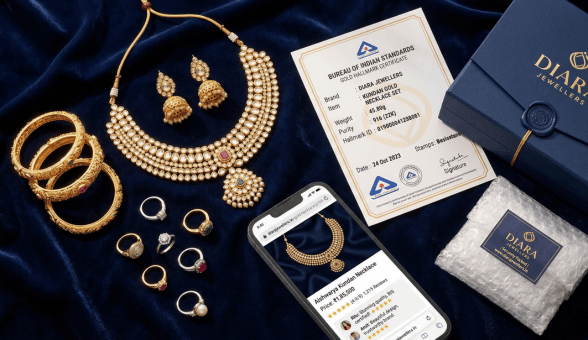
Under the current 2026 system, every hallmarked piece carries three marks: the triangular BIS logo, the purity grade and fineness number, and the 6-digit HUID code. The HUID allows customers and enforcement authorities to verify authenticity through the BIS Care App by simply scanning or entering the code. This traceability feature is a powerful trust signal you can actively communicate to online buyers.
How to Obtain BIS Hallmark Registration
A jeweller who wishes to sell BIS hallmarked jewellery must first obtain hallmark registration from BIS for each sales outlet, including online stores. The registration process involves applying through the BIS Manak Online portal, submitting business documents including GST registration, PAN, and address proof, paying the prescribed registration fee (which varies based on city population tier and expected turnover), and passing a BIS inspection of the premises.
Once registered, jewellery pieces are submitted to a BIS-accredited Assaying and Hallmarking Centre (AHC) for testing. The AHC conducts a homogeneity test, a purity test on a randomly selected sample from the batch, and marks each piece individually using laser or press engraving. The HUID is registered against your BIS license at this stage. A full directory of accredited AHCs is available on the Bureau of Indian Standards official website.
| Registration Step | Detail |
| Apply on BIS Manak Online portal | Complete application with business details |
| Submit supporting documents | GST, PAN, Aadhaar, address proof, turnover estimate |
| Pay registration fee | Fee varies by city population tier |
| BIS inspector site visit | Premises inspection and compliance verification |
| Receive Hallmark Registration Certificate | Issued via email on approval |
| Submit jewellery to AHC for hallmarking | Per-batch process with purity testing and HUID assignment |
Certifications Beyond BIS: Building Layered Trust
BIS hallmarking covers gold and silver purity. But jewellery selling often involves additional materials and claims that require separate certifications or disclosures. Online buyers who cannot physically inspect a piece rely entirely on the documentation you provide.
Diamond and Gemstone Certification
If you sell diamond jewellery, a gemological certificate from a recognised laboratory is essential for any piece priced above Rs. 15,000 to 20,000. The three laboratories whose certificates carry consistent buyer recognition in the Indian market are GIA (Gemological Institute of America), IGI (International Gemological Institute), and SGL (Solitaire Gemological Laboratories). Each certificate documents the 4Cs of the diamond: cut, colour, clarity, and carat weight.
For online selling, photographing the certificate alongside the piece and uploading both the certificate image and a machine-readable certificate number to the product page gives buyers the ability to independently verify the stone’s quality. This verification option is a powerful conversion signal for high-value pieces.
Hallmarking for Silver and Gemstone-Studded Jewellery
Silver hallmarking follows the same BIS framework as gold. BIS 925 certification (Sterling Silver) is the most recognisable standard for online silver jewellery buyers. For pieces that combine metal with precious or semi-precious stones, the metal component is hallmarked while the stone should be accompanied by a separate quality disclosure or gemological certificate depending on the stone type and piece value.
Material Safety and Allergy Disclosure for Fashion Jewellery
Fashion and imitation jewellery that does not contain precious metals has different requirements. Many fashion jewellery buyers have metal sensitivities, particularly to nickel. Disclosing the base metal composition, confirming the piece is nickel-free where applicable, and stating the plating material and estimated thickness builds trust and reduces returns from allergic reactions. This information should appear as a standard field on every fashion jewellery product listing.
| Jewellery Type | Required Certification | Where to Display |
| 22K/18K/14K Gold | BIS Hallmark + HUID | Product title, description, certificate image |
| Silver jewellery | BIS 925 or 999 hallmark | Product description, purity tag image |
| Diamond jewellery | GIA / IGI / SGL certificate | Product page, certificate number field |
| Gemstone jewellery | Gemological lab certificate | Product description, downloadable PDF |
| Fashion / imitation | Metal composition disclosure | Material specifications section |
| Gold-plated jewellery | Base metal + plating details | Specifications section, FAQ section |
Jewellery Photography That Converts
Product photography is where the majority of online jewellery stores either win or lose the sale before a customer even reads the description. Jewellery is highly reflective, small in scale, and deeply tactile. Translating those qualities to a photograph that communicates beauty, quality, and scale simultaneously requires deliberate technique.
The Essential Shot Types for Every Jewellery Listing
- Hero shot: Clean white or neutral background, single piece, high resolution, centered. This is the primary listing image and must load fast without sacrificing clarity.
- Detail shot: Macro closeup of the hallmark stamp, setting quality, stone placement, or craftsmanship detail. This is the image that answers the buyer’s quality question.
- Lifestyle shot: Piece worn on a person, showing scale and how it sits on the body. A gold necklace needs to be seen on a neck, not floating in isolation.
- Scale reference shot: Piece next to a ruler or common object for size context. Jewellery buyers frequently complain that items look larger in photographs than they are in reality.
- Certificate shot: Clear photograph of the hallmark certificate or gemological certificate alongside the piece. This is the trust-building shot that converts hesitant buyers.
Lighting Principles for Jewellery
Soft diffused light minimises harsh reflections on metal surfaces. Direct flash creates blown-out hotspots that obscure detail and make gold look cheap. A lightbox with two soft-box light sources on either side, or natural window light with a white reflector card on the opposite side, produces the clean, even illumination that makes jewellery photography work. For diamonds and gemstones, a small amount of directional light creates the sparkle that communicates stone quality.
What Not to Do in Jewellery Photography
- Never use flash directly on the piece
- Never photograph gold on a yellow background as it makes the metal look artificial
- Never crop so tightly that the complete piece is not visible in the hero shot
- Never use excessive digital enhancement that makes the piece look different from reality, as this drives returns and negative reviews
- Never skip the scale reference shot on pieces above Rs. 5,000 in value
Launching Your Jewellery Brand Online?
Writing Product Descriptions That Build Trust and Drive Decisions
Jewellery product descriptions serve a dual function. They answer the factual questions a buyer needs resolved before purchasing, and they connect emotionally with the occasion or sentiment the piece represents. A description that only lists specifications feels clinical. A description that only tells a story without specifications feels evasive. The combination of both is what converts.
The Specification Block Every Jewellery Listing Needs
- Metal type and purity (22K Gold, BIS 916 Hallmark, HUID: AB1234)
- Weight of metal in grams
- Stone type, cut, and quality grade if applicable
- Dimensions: length, width, height, or diameter as relevant to the piece
- Plating information if applicable (Gold plated, micron thickness, base metal)
- Finishing: Matte, polished, oxidised, rhodium plated
- Closure type for necklaces and bracelets
- Occasion suitability: Daily wear, festive, bridal, office
The Story Element
After the specifications, two to three sentences that connect the piece to its purpose or craft tradition dramatically increase the emotional resonance of the listing. A Kundan necklace deserves a sentence about Rajasthani craftsmanship. A temple jewellery set deserves context about its Kanchipuram or Nagercoil origin. An everyday gold ring deserves a sentence about what it is designed to feel like at 7 AM when you put it on for the day. Specificity creates connection.
Answering the Three Questions Every Jewellery Buyer Has
| Buyer Question | Where to Answer It |
| Is this real / is this the quality you claim? | BIS hallmark details, HUID code, certificate image |
| What will this look like on me? | Lifestyle shot, dimensions, weight description |
| What if I am not satisfied? | Return policy, sizing guidance, exchange process |
Packaging Jewellery for Online Delivery: Protection and Presentation
Packaging for online jewellery serves two distinct purposes. The outer layer protects the piece in transit through a courier network that is not always gentle with parcels. The inner layer creates the unboxing experience that shapes the customer’s perception of your brand at the moment of first physical contact with the product.
The Three-Layer Packaging System for High-Value Jewellery
Layer 1: Inner presentation packaging.
The piece sits in a branded jewellery box or pouch. For fine jewellery, a rigid box with a velvet insert is the standard. For fashion jewellery, a quality kraft or printed pouch can work. The box or pouch should carry your brand name and logo. Include the hallmark certificate or gemological certificate inside this layer, either loose or in a small branded envelope. A handwritten or printed care card with cleaning and storage instructions builds a strong brand impression at this stage.
Layer 2: Protective cushioning.
Wrap the jewellery box in bubble wrap or foam padding before placing it in the shipping box. High-value pieces, particularly those with gemstones or delicate settings, benefit from two rounds of bubble wrapping. The piece should have zero movement inside the shipping box when the box is shaken. Movement equals risk of damage in transit.
Layer 3: Outer shipping box.
A corrugated cardboard box appropriately sized for the piece. Oversized boxes create movement risk. Undersized boxes risk crushing. The outer box should be sealed with strong tape on all seams, not just the closure flap. For high-value shipments, tamper-evident sealing tape that changes color or pattern when broken gives customers visual assurance that the package has not been opened in transit.
| Piece Value | Recommended Outer Packaging | Additional Security |
| Under Rs. 2,000 | Rigid envelope or small corrugated box | Standard courier |
| Rs. 2,000 to Rs. 15,000 | Corrugated box, double taped | Tamper-evident tape, tracking |
| Rs. 15,000 to Rs. 1 lakh | Double-walled corrugated box | Insurance, signature on delivery |
| Above Rs. 1 lakh | Double-walled box with foam insert | Declared value shipment, insurance |
Shipping Insurance for High-Value Jewellery
Courier companies in India have standard liability limits that are far below the value of most fine jewellery shipments. Shipping a Rs. 80,000 gold necklace through a courier without declared value insurance means your entire claim is capped at the courier’s standard liability, which may be Rs. 5,000 to Rs. 10,000.
For any jewellery shipment above Rs. 15,000, declared value shipping with transit insurance is not optional. Most major courier partners operating through integrated e-commerce platforms support declared value shipping. Confirm that your platform’s courier integration supports insurance options for high-value jewellery shipments. Boomimart’s order management system integrates with courier partners that support declared value and high-value category shipping rules.
Building Customer Trust Before the Purchase
The trust gap in online jewellery shopping is real and significant. Customers are being asked to spend meaningful amounts of money on a product they cannot touch, try on, or have evaluated by someone they know. Every trust signal you build into your store’s experience narrows that gap.
Trust Signals That Work for Indian Online Jewellery Buyers
- Prominently display BIS hallmark details on every precious metal product listing. Do not bury this in the description. Lead with it.
- Link to the BIS Care App HUID verification from the product page so buyers can independently verify the piece’s hallmark status
- Display real customer reviews with photographs. Jewellery reviews that include unboxing or worn photos are particularly powerful because they answer the ‘what will this look like in real life’ question
- Show a clear, detailed return and exchange policy specific to jewellery. Include sizing guidance for rings and bangles, and explain the return process for customised pieces
- Offer a video consultation option for pieces above a certain value threshold. A 10-minute WhatsApp video call where a representative shows the piece in natural light and answers questions converts hesitant buyers who would otherwise abandon
- Display your BIS registration number and physical business address. Online jewellery buyers are understandably cautious about invisible sellers
COD Policy for Jewellery
Cash on delivery for high-value jewellery presents significant RTO and fraud risk. Most established online jewellery brands cap COD availability at Rs. 5,000 to Rs. 10,000 and require prepaid payment above that threshold. If you offer COD, an OTP confirmation call before dispatch reduces failed delivery and tampering-at-door incidents significantly.
Handling Returns and Exchanges in Online Jewellery
Returns in jewellery require more care than returns in most other categories. A returned piece must be verified for integrity, confirming it is the same piece, the hallmark is intact, and the piece is in original condition before a refund is processed. Building this verification step into your returns workflow protects against fraud while keeping the process fair for genuine return cases.
What Your Jewellery Return Policy Should Cover
- Return window: 7 to 15 days is standard for most online jewellery brands. Longer windows build trust but require stricter verification on returned pieces.
- Condition requirement: Piece must be unworn, with all original tags, certificates, and packaging intact. Worn pieces with scratches or sizing adjustments made are typically non-returnable.
- Customised pieces: Explicitly state that pieces with name engravings or custom sizing are non-returnable unless there is a manufacturing defect.
- Size exchange: For rings and bangles, offer a free size exchange within 15 days. Sizing guidance on the product page should minimise sizing errors in the first place.
- Refund timeline: State a clear processing period. 5 to 7 business days after receipt of returned piece is a realistic and defensible commitment.
Your return policy for jewellery is as much a marketing asset as it is an operational policy. A clear, customer-friendly return policy displayed prominently on product pages regularly converts buyers who were hesitant. Platforms like Boomimart allow return policy configuration at the product category level, so your jewellery category can have a distinct policy from your fashion accessories category.
Pricing Jewellery for Online Sale: Transparency Builds Confidence
Gold jewellery pricing in India is linked to daily gold rates, which fluctuate with commodity markets. Displaying your pricing methodology transparently, explaining that the metal price component is calculated on the daily gold rate on the date of order and that making charges are separately disclosed, removes a major source of buyer skepticism.
Pricing Transparency Best Practices
- Display the gold rate used in pricing (e.g., ‘Priced at 22K gold rate of Rs. 6,450/gram on March 19, 2026’)
- Separately display making charges as a percentage or per-gram amount
- For GST-included pricing, note that GST at 3 percent on gold jewellery and 5 percent on making charges is included in the displayed price
- For fashion jewellery, a clear MRP label with the material composition avoids the perception of arbitrarily inflated prices
This level of pricing transparency directly counters the most common objection in online jewellery sales: the suspicion that online sellers price arbitrarily because buyers cannot easily comparison-shop metal content. Sellers who display transparent price breakdowns consistently report higher add-to-cart rates on gold jewellery listings. For broader context on e-commerce pricing strategy, the Boomimart guide on product bundling and pricing covers related pricing mechanics applicable across categories.
Marketing Your Online Jewellery Store in India
Jewellery marketing in India operates around a calendar of purchase occasions. Akshaya Tritiya, Diwali, Dhanteras, wedding seasons (particularly October to February and April to May), and festivals specific to regional communities each drive concentrated buying intent that targeted content and paid campaigns can capture.
Content That Works for Jewellery Brands
- Occasion-specific collections: Build dedicated landing pages for Akshaya Tritiya gold, Dhanteras silver gifting, and bridal jewellery by budget range.
- Educational content: How to check BIS hallmark, how to store gold jewellery, how to identify real silver, and how to read gemological certificates are search-intent content that attracts buyers in research mode.
- Customer stories: Wedding jewellery stories, inheritance piece restoration stories, and first-gold-purchase stories build emotional resonance that product pages cannot.
- Behind the craft: Short videos or photo essays showing artisan workshops, the hallmarking process, or the stone-setting technique differentiate handmade jewellery sellers from mass-market competitors.
WhatsApp as a Sales and Trust Channel
Many Indian jewellery buyers want to ask questions before purchasing. A WhatsApp Business number linked from every product page, with a response time commitment of under 2 hours during business hours, converts significantly for jewellery categories above Rs. 10,000. Video calls for piece verification, custom order discussions, and post-purchase check-ins can all happen through this channel and build a level of personal relationship that pure e-commerce interfaces cannot replicate.
Frequently Asked Questions
Is BIS hallmarking mandatory for all jewellery sold online?
BIS hallmarking is mandatory for gold and silver jewellery in districts designated under the Hallmarking of Gold Jewellery and Artefacts Order. As of 2026, hallmarking has been extended across 350-plus districts in India. Fashion and imitation jewellery that does not contain precious metals is not subject to BIS hallmarking requirements but requires material disclosure. The BIS official portal maintains an updated list of designated districts and requirements.
Can I sell antique or heirloom jewellery online without BIS hallmarking?
Antique and heirloom jewellery that pre-dates the mandatory hallmarking period can be sold with appropriate disclosure that the piece is pre-BIS hallmarking era and the purity is estimated rather than certified. Including a third-party assay report that confirms the approximate metal content provides buyers with a reasonable substitute for hallmarking in these cases. Be explicit in the product description and avoid making purity claims you cannot document.
What courier should I use for high-value jewellery shipments?
For jewellery above Rs. 50,000 in value, use couriers that offer declared value shipping with transit insurance. Confirm the maximum insurable value per shipment with your courier partner before dispatching high-value pieces. Require a signature on delivery for all pieces above Rs. 10,000. Avoid leaving high-value jewellery parcels for open-door delivery without signature confirmation, as fraud claims on undelivered valuable items are difficult to resolve without delivery proof.
How do I handle a customer who claims the jewellery arrived damaged?
Request an unboxing video as standard policy for high-value jewellery. Communicate this requirement at the time of purchase and in your order confirmation message. An unboxing video establishes the condition of the outer packaging and the piece at the moment of receipt. If your packaging three-layer protocol was followed correctly, a video that shows intact outer packaging and intact inner packaging provides evidence that any damage occurred during customer handling rather than in transit.
How much should I invest in packaging for a jewellery startup?
For a jewellery startup, branded inner packaging, meaning a printed box or pouch with your logo, is the highest priority investment. The difference between sending a gold ring in a plain white cotton pouch versus a branded jewellery box is the difference between a functional transaction and a branded experience. Budget Rs. 30 to Rs. 150 per unit for inner packaging depending on your price point, and treat it as part of your cost of goods rather than an optional expense.
Can I sell jewellery on my own store and on marketplaces simultaneously?
Yes, and it is a sensible strategy. Your own store protects your margins and builds your brand equity. Marketplace presence on platforms like Amazon or Flipkart Jewellery gives you access to high-intent buyers who may not discover your brand organically. The operational challenge is managing inventory and pricing consistently across channels. Boomimart’s multi-channel selling features allow inventory synchronisation across your own store and marketplace channels, preventing overselling and price discrepancies.