
GoDaddy E-commerce vs Boomimart: Can a Domain Host Run Your Indian Store?

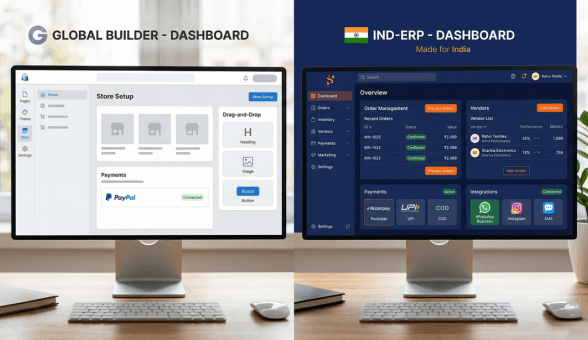
GoDaddy is a name almost every Indian entrepreneur recognises. If you have ever registered a domain name, there is a reasonable chance it was through GoDaddy. The company has spent decades building brand recognition in the domain and hosting space, and that familiarity creates a natural gravitational pull when a first-time seller thinks about setting up an online store. The logic seems straightforward: you already use GoDaddy for your domain, why not use it for your store too?
It is a reasonable question, and it deserves a serious answer rather than a reflexive dismissal. GoDaddy does offer e-commerce functionality. For a certain kind of seller, it can get a basic online presence live quickly. But the gap between a basic online presence and a functional Indian e-commerce operation is significant, and understanding exactly where GoDaddy reaches its limits helps you make a decision you will not need to revisit six months later when you are already mid-operation.
This comparison looks at GoDaddy’s e-commerce offering against Boomimart across the dimensions that matter most to Indian sellers: payment infrastructure, GST and compliance, inventory management, order operations, mobile experience, and total cost of running the store. The goal is not to dismiss one platform but to map each to the buyer it actually serves.
What GoDaddy Actually Offers as an E-commerce Platform
GoDaddy started as a domain registrar and web host. Its e-commerce functionality has been added progressively over years as the company expanded its product surface. The result is an e-commerce offering that is genuinely useful for a narrow use case but carries real gaps for anyone building a serious Indian retail operation.
The GoDaddy Online Store provides a drag-and-drop website builder with around 100 mobile-ready templates, basic product management, built-in marketing tools, and integration with major international marketplaces like Amazon and Etsy. The Commerce plan, which is the one that includes full e-commerce functionality, is priced internationally at around USD 26.99 per month. The builder is designed for speed of setup: a first-time seller can have a product listed and a checkout active within a few hours. That speed is a genuine strength.
The limitations become visible when you bring Indian operational requirements into the picture. GoDaddy was not designed with the Indian market as the primary context. Its payment infrastructure, tax handling, and operational depth reflect a platform built for western markets first, adapted for India second. That sequence matters for sellers who need UPI support, Razorpay or PayU integration, GST invoice automation, COD workflows, and a shipping layer that connects to Indian courier networks.
Payment Infrastructure: The Most Critical India-Specific Gap
Payment is the first test any Indian e-commerce platform must pass. The Indian digital payments landscape in 2026 is dominated by UPI, which handles over 50 percent of all retail digital payment transactions in India by volume. A store that cannot accept UPI natively at checkout is working against the dominant behaviour of its buyer base from the moment of launch.
GoDaddy’s built-in payment processing is primarily designed around international gateways: PayPal, Stripe, and Square. These work well for US and European markets. For Indian buyers, PayPal is used by a small segment, Stripe has expanded in India but is not universally familiar, and Square has no meaningful presence in the Indian market. Enabling UPI on a GoDaddy store requires workarounds or third-party gateway integrations that add technical complexity, additional fees, and support overhead that defeats the simplicity that attracted the seller to GoDaddy in the first place.
A connected point is checkout domain redirection. Independent testing of GoDaddy’s e-commerce platform has documented that when a buyer proceeds to checkout, they are sometimes redirected away from the seller’s domain to a generic checkout domain. For Indian buyers who are already cautious about online transactions, landing on an unfamiliar domain at the payment stage is a conversion-killing trust signal. Boomimart’s Commerce Cloud keeps the entire purchase journey on the seller’s branded domain and includes native integration with Razorpay, PayU, UPI, and COD out of the box, with no configuration overhead for the seller.
GST, Invoicing, and Indian Compliance
Every cosmetic product sold in India, and most other product categories, must be invoiced with GST details. A GST-compliant invoice includes the seller’s GSTIN, buyer GSTIN where applicable, HSN code for the product, applicable tax rate, tax amount, and invoice number in a defined sequence. Generating these manually for every order is an error-prone, time-consuming process that creates compliance risk during filing periods.
GoDaddy’s e-commerce tools do not include native GST invoice generation calibrated for Indian compliance requirements. The platform’s tax handling was built around western tax structures, which differ significantly from India’s multi-tier GST framework. Indian sellers on GoDaddy typically need to generate GST invoices outside the platform using separate accounting software and then reconcile the records manually.
Boomimart’s ERP layer handles GST invoice generation automatically at the point of order confirmation. The invoice pulls the product’s HSN code from the catalog, applies the correct GST rate, generates a sequentially numbered invoice, and makes it available for download and dispatch. The quarterly GST reconciliation becomes a structured data export rather than a manual reconstruction of records. For any Indian seller operating at meaningful volume, this single difference represents several hours of compliance work saved every month.
Feature-by-Feature Comparison for Indian Sellers
| Feature | GoDaddy Online Store | Boomimart Commerce Cloud |
| UPI payment acceptance | Requires third-party workaround | Native, built-in |
| Indian payment gateways (Razorpay, PayU) | Limited / manual integration | Pre-integrated, no setup needed |
| COD (Cash on Delivery) | Not natively supported | Full COD workflow with OTP verification |
| GST invoice auto-generation | Not available | Automatic on order confirmation |
| WhatsApp integration | Not available | Built-in for order updates and customer support |
| Inventory management (ERP) | Basic product catalog only | Full ERP with multi-location stock |
| Vendor and procurement management | Not available | Included in platform |
| Mobile admin app | Limited | Full-featured mobile admin app |
| Order management with automation | Basic order view | Automated workflow with status triggers |
| Indian courier integration | Not available | Supports Indian courier partners |
The table above illustrates the core difference between the two platforms. GoDaddy’s e-commerce layer was built as an extension to a website builder. Boomimart was built as an operations platform first, with a website and mobile app as the customer-facing output of a deeper commerce ERP. The seller’s day-to-day work operates primarily in the operations layer, not in the website builder, which is why the ERP depth matters more than website template variety for anyone building a real business.
See Boomimart's Full Feature Set in Action
The Website Builder Comparison: Where GoDaddy Has a Real Edge
It would be inaccurate to position GoDaddy as inferior across all dimensions. For the specific task of building a visually polished website quickly with no technical background, GoDaddy’s drag-and-drop builder is genuinely easy to use. The template library is well-designed by global standards, and the onboarding process walks a complete beginner through setup in a way that requires no prior web experience.
If your primary requirement is a brand presence website with a small product catalog, light selling volume, and international buyers paying in USD or GBP, GoDaddy can serve that need adequately. A consultant, a creative professional selling a handful of digital products, or a small handicraft seller targeting diaspora buyers outside India might find GoDaddy’s setup speed and simplicity genuinely valuable.
The limitation emerges the moment the operation needs to scale. GoDaddy has been documented as lacking features that are standard on most serious e-commerce platforms: customisable email receipts for customers, straightforward multi-rate tax application, flexible coupon and discount configuration, and advanced product variant management. These are not edge-case features. They are the basic mechanics of running a growing Indian online store at even moderate volume.
Pricing: What You Actually Pay to Run Each Platform
| Cost Component | GoDaddy Commerce Plan | Boomimart |
| Monthly platform fee | ~USD 26.99 (~Rs. 2,250) | Flat Indian rupee pricing |
| Indian payment gateway | Separate integration cost | Included in platform |
| GST invoicing tool | Separate accounting software needed | Included in platform |
| WhatsApp integration | Separate tool needed | Included in platform |
| Vendor management | Not available | Included in platform |
| Mobile admin app | Basic / limited | Included in platform |
The headline price comparison favours GoDaddy at first glance: the Commerce plan appears affordable. The real cost picture changes when you add the tools required to run a compliant Indian store. Separate GST invoicing software typically costs Rs. 500 to Rs. 2,000 per month. A third-party Indian payment gateway integration may involve setup costs plus developer fees. WhatsApp Business API integration for customer communications adds further cost. By the time a GoDaddy store has the operational capabilities that Boomimart includes natively, the total monthly outlay is often higher than a purpose-built Indian e-commerce platform. Boomimart’s pricing page shows the all-inclusive plan structure where all of these tools are included rather than billed as separate line items.
The Indian Seller’s Decision Framework
The choice between GoDaddy and a purpose-built Indian e-commerce platform is not primarily a price decision. It is a use-case decision. These questions help clarify which platform actually fits your situation.
Choose GoDaddy if:
- You are building a brand presence website primarily, not a high-volume transactional store
- Your buyers are predominantly international and pay in foreign currency via international gateways
- You are selling a small number of digital products or services rather than physical goods
- Your volume is very low, under 20 to 30 orders per month, and manual processes are manageable
- You specifically need GoDaddy’s domain management and website hosting bundled with a basic store
Choose Boomimart if:
- You are selling physical products to Indian buyers who expect UPI, COD, and Razorpay at checkout
- You need GST-compliant invoices generated automatically per order
- You are processing or planning to process more than 30 to 50 orders per month
- You need WhatsApp integration for order updates and customer support
- You want inventory management, vendor management, and order automation in one platform
- You are building a D2C brand with an Indian customer base and want the operations to scale
The comparison between Boomimart and Shopify covers a similar set of questions from the angle of feature depth vs international platform reach, which is useful context for sellers evaluating multiple options simultaneously.
What Sellers Who Switch Typically Report
Sellers who start on GoDaddy and move to a purpose-built Indian e-commerce platform consistently report that the migration decision was triggered by one of three specific friction points rather than a generalised dissatisfaction with the website quality.
The first trigger is payment friction. Indian buyers abandoning checkout at higher rates than expected, specifically at the payment step where UPI or Razorpay is not available, is the most commonly cited reason for switching. A seller who sees a 40 to 50 percent checkout abandonment rate on a product that should convert well is usually facing a payment infrastructure problem, not a product or pricing problem.
The second trigger is GST filing pain. After the first quarterly GST filing, sellers who have been manually reconstructing invoice data from GoDaddy’s order exports into accounting software understand the ongoing compliance cost of running a store that was not designed with Indian tax law in mind. The workload is not unmanageable at low volume but becomes a significant monthly overhead as order counts grow.
The third trigger is operational complexity. As a store grows beyond 50 to 100 orders per month, the absence of automated order status notifications, integrated courier assignment, and inventory deduction creates manual work that slows fulfilment and increases error rates. The seller finds themselves managing their business across three or four disconnected tools where a single integrated platform would handle everything from one dashboard.
See Boomimart's Full Feature Set in Action
Domain and Hosting: Where GoDaddy Remains the Better Choice
One area where this comparison is unambiguously in GoDaddy’s favour is domain registration and management. GoDaddy is among the world’s largest domain registrars, with deep tooling for domain search, privacy, management, and transfer. If you need to register and manage domains at scale, or if you are a domain investor, GoDaddy’s domain infrastructure is purpose-built for that task.
The practical implication for Indian e-commerce sellers is that using GoDaddy for domain registration while running your store on a dedicated Indian e-commerce platform is a perfectly sensible approach. You can point your GoDaddy-registered domain to a Boomimart store with a simple DNS configuration. The two tools serve entirely different purposes, and there is no technical or operational reason to use a single provider for both when the better solution is to use each platform for what it does best.
Frequently Asked Questions
Can I use my GoDaddy domain with a Boomimart store?
Yes. Domain registration and e-commerce platform are independent functions. You register and manage your domain on GoDaddy, then point the domain’s DNS settings to your Boomimart store. The process typically takes 24 to 48 hours for DNS propagation and requires no technical expertise beyond updating two records in your GoDaddy domain management panel.
Does GoDaddy support Razorpay or PayU for Indian stores?
GoDaddy’s built-in payment tools are primarily designed for international gateways like PayPal and Stripe. Integrating Indian-specific payment gateways like Razorpay or PayU requires custom development or third-party plugins that add cost, maintenance overhead, and technical complexity. This is not a simple toggle-on feature within GoDaddy’s standard e-commerce interface.
Is GoDaddy suitable for a seller expecting 200 to 300 orders per month?
At 200 to 300 orders per month, GoDaddy’s e-commerce tools would require the seller to manage GST invoicing externally, handle order notifications manually or through a separate tool, use a separate courier integration, and reconcile payment gateway data outside the platform. The operational overhead makes it a poor fit at that volume. A purpose-built Indian e-commerce ERP that automates these workflows is significantly more efficient at that scale.
What is the difference between GoDaddy’s website builder and an e-commerce ERP?
A website builder creates a storefront: product pages, a shopping cart, and a checkout. An e-commerce ERP manages the operations behind the storefront: inventory across locations, order workflow automation, GST invoice generation, vendor relationships, expense tracking, customer accounts, and sales reporting. GoDaddy provides the storefront layer with basic extensions toward operational features. Boomimart provides both the storefront and a full ERP layer, which is the distinction that becomes critical as order volume grows beyond the early stage.
Can I migrate my GoDaddy store to Boomimart?
Yes. Boomimart’s migration support covers product catalog transfer, customer data migration, and domain redirection. Most migrations can be completed without technical expertise. The typical timeline for a straightforward product catalog migration is 1 to 3 days, after which the store is live on Boomimart with the same domain pointing to the new platform.
Does GoDaddy generate GST invoices for Indian stores?
GoDaddy does not include native GST invoice generation configured for Indian compliance requirements. The platform’s tax handling was designed around western tax structures. Indian sellers need to generate GST-compliant invoices through separate accounting software and manually reconcile that data with GoDaddy’s order records, which adds regular compliance work that grows with order volume.