
How to Write Product Descriptions That Rank on Google and Convert Browsers

Most Indian e-commerce product pages are doing two things wrong simultaneously. They are too vague to rank on Google and too feature-heavy to convince a real buyer to purchase. The result is a product page that gets almost no organic traffic and converts very little of the traffic it does get.
A product description has two jobs to do at the same time: satisfy a search engine and persuade a human being. These two goals are not in conflict. When you understand what both the algorithm and the buyer are actually looking for, writing product descriptions that do both becomes a learnable, repeatable skill.
Why Most Indian E-commerce Product Descriptions Fail
Before getting into what works, it is worth understanding the specific patterns that cause product descriptions to fail. These four mistakes appear across thousands of Indian e-commerce product pages:
Copying the Manufacturer Description
The most common error. Brands receive a product description from the manufacturer and paste it directly onto their product page. The problem is that every other seller stocking the same product has done the same thing. Google sees duplicate content across hundreds of URLs and assigns no ranking value to any of them. Buyers see generic copy that tells them nothing they could not find on the manufacturer’s own website.
Writing Features When Buyers Want Benefits
There is a meaningful difference between a feature and a benefit. A feature is what a product has. A benefit is what it does for the buyer. “500-thread-count Egyptian cotton” is a feature. “Stays cool through Chennai summers and soft enough that you will not want to get out of bed” is a benefit. Buyers do not buy features. They buy the outcome the feature produces.
Ignoring How People Actually Search
A seller listing “Organic Cold Pressed Groundnut Oil 1 Litre” may be targeting people who search “buy groundnut oil online” when most buyers are actually searching “groundnut oil for cooking” or “cold pressed peanut oil India”. Understanding the language your buyers use, not the language your product label uses, is what determines whether you rank.
Thin Descriptions That Give Google Nothing to Index
A three-line product description with 40 words gives Google almost no content to understand what the page is about. It cannot rank well for any meaningful search term because there is simply not enough text to establish relevance. Product pages need adequate depth to compete in search results, but that depth has to be genuinely useful, not padded with filler.
Understanding What Google Looks for in a Product Page
Search engines rank product pages based on how well they match what a user is looking for. For e-commerce product pages specifically, Google evaluates several factors that your description directly controls.
Keyword Relevance
Google needs to understand what your product is and what searches it should appear for. This means your primary keyword (the main search term you want to rank for) should appear naturally in your product title, the first paragraph of your description, and in the body of the description itself. It should not appear forced or repeated unnaturally. Google is sophisticated enough to penalise keyword stuffing and reward natural usage.
Semantic Depth
Modern Google does not just look for exact keyword matches. It looks for related terms and contextual signals that confirm a page is genuinely about a topic. A product description for a cotton kurti that also mentions “breathable fabric”, “summer wear”, “machine washable”, and “ethnic wear for women” sends strong semantic signals that help the page rank for a wider range of related searches.
Unique Content
Pages with unique, original product descriptions are given preference over pages with duplicated manufacturer copy. This is one of the clearest opportunities for Indian e-commerce sellers to outperform larger competitors: write original descriptions for your products, and your pages immediately become more rankable than competitors who copied the same generic text.
Page Engagement Signals
Google also monitors how users behave on your page after clicking from search results. If visitors land on your product page and immediately go back to Google (a high bounce rate), that signals the page did not deliver what they expected. A well-written description that immediately answers the buyer’s key questions keeps them on the page longer, which sends positive signals back to the algorithm.
Want Better-Ranking Product Pages?
Keyword Research for Indian E-commerce Product Pages
Before you write a single word, you need to know which search terms your buyers are actually using. Keyword research for product descriptions is not about finding the highest-volume terms. It is about finding the terms with genuine buyer intent that your page can realistically rank for.
Start With How Your Customers Talk, Not How You Talk
A seller who makes handwoven Ikat fabric might naturally use terms like “double Ikat silk” and “resist-dyeing technique”. Their buyers are more likely to search “handwoven saree online” or “traditional Odisha fabric” or “authentic Indian silk saree”. Talk to your existing customers, read the questions in your WhatsApp groups, and look at what competitors rank for. The gap between how sellers describe products and how buyers search for them is where most keyword opportunities hide.
Tools for Finding the Right Keywords
Several free and low-cost tools help identify what Indian buyers are actually searching for:
- Google Search autocomplete: Type your product name into Google and see what autocomplete suggestions appear. Each suggestion is a real search people have made recently.
- Google’s “People also ask” and “Related searches” sections: Scroll to the bottom of a Google results page for your product term. The related searches listed there are additional keyword opportunities for your description.
- Google Keyword Planner (free with a Google account): Shows search volume and competition level for specific terms. Focus on terms with clear buying intent (searches that include words like “buy”, “online”, “price”, “best” tend to indicate purchase intent).
- Amazon and Flipkart search autocomplete: These platforms have massive search data from Indian buyers. Searching your product on these platforms reveals how buyers phrase their searches in the Indian context.
Types of Keywords to Include in a Product Description
| Keyword Type | Example | Where to Use It |
| Primary Keyword | “cold pressed coconut oil India” | Product title and first paragraph |
| Long-tail Keyword | “cold pressed coconut oil for cooking and hair” | Body of description and bullet points |
| Semantic / Related Terms | “virgin coconut oil”, “unrefined”, “chemical-free” | Throughout description naturally |
The Structure of a High-Converting, High-Ranking Product Description
A product description that both ranks and converts follows a specific structure. Each section serves a distinct purpose for either the search engine or the buyer, and the best descriptions serve both simultaneously.
Section 1: The Benefit-Led Opening (50 to 80 words)
The first paragraph of your description is the most important. It is where your primary keyword should appear naturally, and it is the first thing a buyer reads after looking at your product image. Lead with the core benefit, not the product name repeated.
The strong version contains the primary keyword naturally, establishes the key benefit (nutrition retention, no chemicals), and speaks to multiple use cases that expand keyword reach.
Section 2: Benefit Bullet Points (4 to 6 bullets)
After the opening paragraph, bullet points let buyers scan quickly for the information that matters most to them. Each bullet should lead with the benefit and follow with the feature that delivers it. Keep each bullet to one to two lines. Long bullet points defeat the purpose of scannable formatting.
Section 3: The Usage or Story Paragraph (60 to 100 words)
This is where many sellers stop, and where a real opportunity exists. A short paragraph describing how the product is used, who uses it, or the context in which it is used adds semantic depth, keeps the buyer engaged, and naturally incorporates additional keywords without forcing them.
For a product like a hand-embroidered kurta: “Our Lucknowi Chikankari kurtas are designed for the woman who appreciates the craft behind the clothing she wears. Each piece takes between 12 and 18 hours of hand embroidery by artisans in Lucknow who have practiced the craft across generations. Worn to a family function or an office festive event, the drape and detail speak for themselves.”
This paragraph adds keywords (Lucknowi Chikankari, hand embroidery, artisans) while building the emotional connection that converts a browser into a buyer.
Section 4: Technical Specifications (in a structured format)
Buyers making considered purchase decisions need specific details: dimensions, weight, material composition, care instructions, certifications, country of origin, compatibility. Present these in a clean structured format rather than buried in prose. For Indian buyers especially, GST-inclusive pricing information and FSSAI certification for food products, BIS marking for electronics, and GI tags for craft products are trust signals that belong in this section.
Writing for the Indian Buyer: Specific Considerations
Indian e-commerce buyers have specific expectations and concerns that are different from buyers in Western markets. Product descriptions that acknowledge these directly convert better.
Address the COD and Return Question Proactively
Many Indian buyers, particularly in Tier 2 and Tier 3 cities, are still cautious about prepaid online purchases. Including a brief mention of your return policy, COD availability, or satisfaction guarantee within or near the product description reduces purchase hesitation significantly. This does not need to be a separate policy page link. A single sentence within the description (“Easy returns within 7 days, no questions asked”) can make a measurable difference to conversion rates.
Use Vernacular Search Terms Where Relevant
Many Indian buyers search in a mix of English and their regional language. A seller of traditional Tamil Nadu bronze oil lamps might find that some buyers search “bronze lamp” while others search “vilakku” or “karthigai vilakku”. Including both the English term and the commonly used Indian term in your description captures both audiences without appearing forced or unnatural.
Clarify Measurements in Indian Context
Sizes, weights, and volumes that feel standard to a seller often create confusion for a buyer. A “medium” kurta size varies by brand. “500ml” of ghee may be unclear to a buyer used to thinking in “grams”. Where possible, add the Indian reference point: “500ml (approximately 460 grams of pure ghee)” or “Medium (fits chest sizes 38 to 40 inches, equivalent to Indian size 40)”.
Certifications and Authenticity Markers
Indian buyers have been burned often enough by misrepresented products that authenticity markers carry real weight. FSSAI certification for food products, BIS hallmark for gold and silver jewellery, AYUSH registration for herbal products, and GI tags for craft items should be prominently mentioned in descriptions. These are not just legal requirements in many cases, they are genuine conversion tools.
| Product Category | Key Trust Signal to Include |
| Food and Grocery | FSSAI license number, expiry date, organic certification if applicable |
| Jewellery | BIS hallmark, metal purity (916 gold, 925 silver), certificate of authenticity |
| Herbal and Ayurvedic | AYUSH registration, ingredient list, no harmful additives statement |
| Handloom and Handicraft | GI tag (if applicable), handmade declaration, artisan region |
Want Better-Ranking Product Pages?
On-Page SEO Elements Beyond the Description Text
The written description is the most important element, but several supporting on-page elements also affect how well your product page ranks. Neglecting these while writing excellent descriptions leaves meaningful ranking potential on the table.
Product Title (H1)
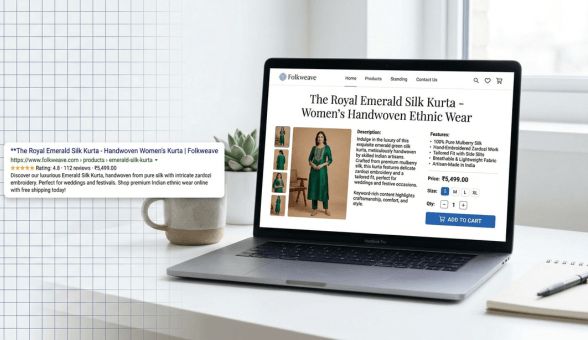
Your product title is the single most important on-page SEO element. It should include your primary keyword, be specific, and be under 70 characters so it displays fully in search results without being cut off. For Indian e-commerce products, including the key differentiator in the title (cold pressed, handwoven, GI tagged, A2) adds both keyword relevance and conversion value.
Meta Description
The meta description does not directly affect rankings but it determines whether someone clicks your result when it appears on Google. It should be 140 to 160 characters, include your primary keyword, and contain a clear reason to click. Think of it as a two-line ad for your product page.
Alt Text for Product Images
Every product image should have descriptive alt text that includes the product name and a relevant keyword. This helps Google understand what the image shows, contributes to image search rankings, and improves accessibility. “img001.jpg” as an image name and blank alt text are missed opportunities that most competitors are also missing, meaning this is easy ground to gain.
URL Structure
| On-Page Element | Optimisation Priority | Key Rule |
| Product Title (H1) | Highest | Primary keyword + specific differentiator, under 70 characters |
| Description Opening Paragraph | Highest | Primary keyword in first 100 words, benefit-led |
| Meta Description | High | 140 to 160 characters, includes keyword and click reason |
| Image Alt Text | Medium | Descriptive with product name and keyword, not “image1” |
How to Scale Product Description Writing Without Losing Quality
Writing individual high-quality descriptions for every SKU is manageable at 20 products. At 200 or 2,000 products, it requires a system.
Build a Description Framework for Each Product Category
Create a category-specific template that defines the required sections, the target keyword structure, and the minimum word count. Anyone writing descriptions for your store, whether that is you, a team member, or a freelancer, should follow the same framework. This keeps quality consistent even as volume increases.
Prioritise Your Highest-Traffic and Highest-Margin Products First
Not every product page deserves equal investment. Start with the products that generate the most revenue, the products you are actively promoting, and the products in categories where you have real keyword ranking opportunities. A strong description on your top 20 products will drive more business impact than thin descriptions across 200 products.
Use Customer Reviews as Description Inspiration
Audit and Update Descriptions Regularly
A product description written two years ago may be missing keywords that have become relevant since then, or may no longer reflect updated product specifications, certifications, or packaging. Building a quarterly description audit into your content calendar ensures your product pages stay competitive in search rankings over time.
Want Better-Ranking Product Pages?
Putting It All Together: A Before and After Example
Here is a complete product description rewrite for a common Indian e-commerce product, showing the difference between a typical weak description and a well-structured, SEO-optimised version.
Product: A2 Gir Cow Ghee 500g
After (SEO-Optimised, Conversion-Ready Description):
“Made from the cultured butter of grass-fed Gir cows using the traditional bilona method, this A2 ghee retains the natural butyric acid, CLA, and fat-soluble vitamins that commercial ghee processing destroys. If you have been looking for authentic desi ghee for cooking, Ayurvedic use, or simply because your grandmother’s ghee tasted nothing like what the supermarket sells, this is the closest you will find.”
What makes it different:
- Bilona churned from hand-set curd, not from cream, preserving the full A2 protein structure
- Sourced from Gir cows that graze on open pasture, producing milk with higher nutritional density
- Rich, nutty aroma and golden colour that refined ghee cannot replicate
- No additives, no vegetable fat blending, no artificial flavour
- FSSAI certified, batch tested for purity
“Gir cow ghee has been used in Indian cooking and Ayurvedic practice for centuries. Our Gir herd grazes in Gujarat’s Saurashtra region and is never given synthetic hormones or antibiotics. The bilona churning process is slower and lower yield than industrial ghee production, which is why authentic A2 ghee costs more and delivers more.”
The rewritten description is approximately 220 words compared to the original 30 words. It contains the primary keyword (A2 Gir cow ghee), multiple semantic terms (bilona method, desi ghee, butyric acid, CLA), a story that builds brand trust, benefit-led bullet points, and technical specifications that give Google rich content to index and give buyers the information they need to buy confidently.