Email Marketing for E-commerce: Building a List That Actually Buys

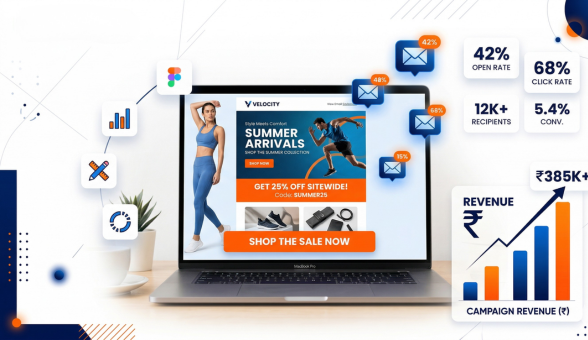
Every Indian e-commerce seller chasing Instagram followers and Meta ad clicks is sitting on a channel that consistently outperforms both: email.
The average ROI on email marketing in e-commerce is around Rs 3,600 for every Rs 100 spent, according to data tracked across global e-commerce benchmarks. For Indian sellers specifically, where customer acquisition costs through paid social are rising every quarter, an owned email list is one of the most durable assets a store can build.
Why Email Outperforms Every Other Marketing Channel for E-commerce
Before getting into the how, it helps to understand why email deserves more of your attention than it typically gets.
You Own the Channel
When Meta changes its algorithm or increases ad costs, your reach drops overnight and there is nothing you can do about it. When Instagram restricts organic reach for business accounts, your follower count becomes largely decorative. Email is different. Your list belongs to you. No platform can take it away, limit your reach to it, or charge you more to access the subscribers you already earned.
Email Buyers Spend More
Customers who come to your store through an email campaign have already opted in to hear from you, which means their intent is meaningfully higher than a cold social media viewer. E-commerce data consistently shows that email-driven sessions convert at 3x to 5x the rate of social media traffic, and the average order value from email buyers is typically higher than from paid channels.
Segmentation Makes Every Rupee Work Harder
A Facebook ad goes to everyone in your target audience whether they have bought from you before or not. An email list can be segmented by purchase history, product category interest, location, lifetime value, and dozens of other variables. A customer who bought a silk saree last Diwali gets a different email than a first-time visitor who browsed your home decor section without buying. That personalisation is what separates stores with good email programmes from stores with generic newsletters nobody reads.
Want to Set Up Email Marketing for Your Boomimart Store? Talk to Our Team
Step 1: Building Your Email List the Right Way
A list of 500 genuinely interested subscribers outperforms a list of 5,000 people who barely remember signing up. List quality determines everything that follows, so getting this step right matters more than anything else.
Capture Emails at Every Touchpoint on Your Store
Your store has multiple natural moments where a visitor is engaged enough to share their email. Most Indian e-commerce stores capture email at only one of them: the checkout. Here are the touchpoints worth activating:
- Welcome popup: A popup that appears 5 to 10 seconds after a new visitor lands on your site, offering a first-purchase discount or free shipping in exchange for an email address. Keep the copy specific: “Get Rs 150 off your first order” converts better than “Subscribe to our newsletter”.
- Exit-intent popup: Triggered when a visitor moves their cursor toward the browser close button or back button. This catches people who are about to leave without buying and gives them one last reason to stay connected.
- Product page sign-up for out-of-stock items: If a product is sold out, offer a “Notify me when available” option that captures email and adds the subscriber to a product-specific restock alert list.
- Post-purchase confirmation page: After a successful order, the customer is at peak brand sentiment. This is an ideal moment to invite them to join a loyalty programme or exclusive subscriber list for early access to new arrivals.
- Checkout email field: Make sure your checkout collects email even for guest purchases. This is often the largest single source of email addresses for Indian e-commerce stores.
Lead Magnets That Work for Indian E-commerce
A lead magnet is something of value you offer in exchange for an email address. For Indian e-commerce sellers, the most effective lead magnets are:
| Lead Magnet Type | Best Suited For | Example Offer |
| Discount on First Order | All product categories | “Get Rs 200 off your first purchase” |
| Free Shipping Offer | Mid-weight products | “Free delivery on your first order over Rs 499” |
| Early Access / Waitlist | Limited edition or seasonal products | “Be first to know when our Diwali collection drops” |
| Useful Content Download | Educational product categories | “Download our saree draping style guide” |
What NOT to Do When Building Your List
Two practices destroy list quality before your email programme even starts:
- Buying email lists: Purchased lists are full of unverified addresses, have no relationship with your brand, will generate spam complaints, and will get your sending domain blacklisted quickly. There is no shortcut here that works.
- Adding customers to a general marketing list without explicit consent: In India, while email regulation is less strict than in the EU, sending unsolicited marketing emails damages your sender reputation and destroys the trust you built during the purchase experience. Always make the subscription opt-in clear.
Step 2: The Email Automations Every Indian E-commerce Store Needs
Automated email sequences are triggered by customer actions rather than sent manually on a schedule. They are the foundation of a high-performing email programme because they deliver the right message at exactly the right moment, without you having to do anything after the initial setup.
1. Welcome Series (Triggered: New Subscriber)
The most important sequence you will build. A subscriber’s engagement is highest in the first 48 hours after joining your list. A welcome series typically runs across 3 emails:
- Email 1 (Immediate): Deliver the promised lead magnet or discount code. Introduce your brand story briefly. Show your bestselling products. Keep it warm and personal.
- Email 2 (Day 2 or 3): Go deeper on what makes your products different. For Indian handicraft or food or apparel brands, this is where the craft story, the sourcing story, or the founder story belongs.
- Email 3 (Day 5 to 7): A gentle nudge toward purchase. Show social proof (customer reviews, UGC photos). Create mild urgency if the discount code is expiring.
2. Abandoned Cart Recovery (Triggered: Cart Abandoned Without Purchase)
A basic three-email cart recovery sequence:
- Email 1 (1 hour after abandonment): Simple reminder with the cart contents. No discount yet. Just a clean, friendly nudge. Subject: “You left something behind.”
- Email 2 (24 hours after abandonment): Address the most likely objection. If it is a fashion product, mention your return policy. If it is food, mention freshness guarantees. Show reviews of the abandoned product.
- Email 3 (48 to 72 hours after abandonment): Last chance message with a small incentive. A 5 to 10 percent discount or free shipping is usually enough. After this, let it go.
3. Post-Purchase Thank You and Onboarding (Triggered: Successful Order)
The post-purchase email sequence is underused by most Indian sellers. After a customer buys, they are at peak positive sentiment toward your brand. This is the moment to:
- Confirm the order with full details and a clear expected delivery date
- Set expectations for packaging and delivery experience, especially for fragile or premium products
- Share care instructions for the product (critical for textiles, handmade items, perishables)
- Invite the customer to follow your brand on social media or join a WhatsApp community
- Introduce your referral programme if you have one
4. Win-Back Campaign (Triggered: No Purchase in 60 to 90 Days)
Every list has subscribers who went quiet. They bought once, or signed up but never purchased, and have not engaged in two to three months. A win-back campaign attempts to re-engage them before they become permanently inactive.
The most effective win-back emails are honest and direct. “We miss you. Here is 15 percent off to come back.” is more effective than a newsletter dressed up as a re-engagement campaign. If a subscriber does not respond to two or three win-back emails, remove them from your active list. A smaller, engaged list always outperforms a large, unresponsive one.
5. Review Request (Triggered: Delivery Confirmed)
Want to Set Up Email Marketing for Your Boomimart Store? Talk to Our Team
Step 3: Campaign Emails That Drive Revenue Without Annoying Your Subscribers
Beyond automations, the emails you send manually on a schedule (called campaign emails or broadcast emails) are what keep your list warm and generate consistent revenue. The biggest mistake Indian e-commerce sellers make with campaign emails is sending too many discounts and too few stories.
The 80/20 Rule for Campaign Email Content
A healthy email content mix looks roughly like this: 80 percent of emails provide genuine value (product education, usage tips, customer stories, brand news, seasonal content) and 20 percent are direct promotional emails with a discount or sale. Sellers who send only discount emails train their subscribers to wait for offers and never buy at full price. Sellers who mix in genuine value build relationships that last.
Campaign Email Types That Work for Indian E-commerce
- New arrival announcements: Show new products with strong visuals, the story behind them, and a clear CTA to shop. Keep copy short. Let the product images do the work.
- Seasonal and festive campaigns: Indian buyers are highly responsive to calendar-driven campaigns. Diwali, Pongal, Eid, Onam, Holi, Raksha Bandhan, and Valentine’s Day all represent genuine purchase intent moments. Plan these campaigns at least three weeks in advance.
- Behind-the-scenes content: A short email showing how your products are made, who makes them, or where your materials come from builds brand differentiation that no discount can replicate. This is particularly powerful for handmade, organic, or artisan product brands.
- Customer spotlight emails: Feature a real customer using your product with their permission. These emails generate some of the highest engagement rates because they feel genuine and show real-world product experience.
- Limited stock alerts: “Only 8 units left of this item” is a legitimate urgency signal when it is true. Scarcity emails work when they are honest and specific.
| Email Type | Send Frequency | Primary Goal |
| New Arrival / Product Launch | With every major new drop | Drive first purchases of new SKUs |
| Festive Campaign | 2 to 3 weeks before key dates | Capture seasonal purchase intent |
| Behind-the-Scenes Story | Once or twice a month | Build brand connection and loyalty |
| Flash Sale / Promotion | Max once or twice a month | Clear stock, drive urgency |
Step 4: Subject Lines That Get Opened in a Crowded Indian Inbox
An email that does not get opened cannot generate revenue. Subject line is the single biggest lever for open rates, and the principles that work in Indian e-commerce inboxes are specific.
What Works in Indian E-commerce Subject Lines
- Specificity over cleverness: “Rs 300 off your next order, valid for 48 hours” outperforms “Something special inside” every time. Indian subscribers respond to clear, direct value statements.
- Personalisation with the subscriber’s name: Subject lines with a first name see 10 to 15 percent higher open rates on average. Even a simple “Priya, your cart is waiting” outperforms the generic version.
- Numbers and specifics: “3 new arrivals from our Rajasthan collection” is more compelling than “New arrivals just dropped”.
- Curiosity gaps used sparingly: “You will not believe what happened to this order” works once. Used repeatedly, it becomes noise that subscribers learn to ignore.
- Regional and seasonal relevance: “Your Diwali gifting sorted in 10 minutes” or “Beat the Chennai summer with these new arrivals” signals that you understand your buyer’s context.
Subject Line Mistakes That Kill Open Rates
- ALL CAPS in the subject line triggers spam filters and reads as shouting
- Excessive punctuation (!!!, ???) reads as spam and reduces deliverability
- Generic subjects like “Monthly Newsletter” or “New Collection” give no reason to open
- Misleading subjects that do not match the email content destroy trust permanently
Step 5: Email Deliverability Getting Into the Inbox, Not the Spam Folder
You can write the best email in the world and it will generate zero revenue if it lands in the spam folder. Deliverability is the unglamorous foundation of email marketing, and Indian sellers who ignore it consistently underperform.
The Basics of Good Deliverability
- Use a branded domain email address for sending (orders@yourbrand.com, not a Gmail or Yahoo address). Sending marketing emails from a personal Gmail address destroys deliverability.
- Authenticate your sending domain with SPF, DKIM, and DMARC records. This tells email providers that your messages are legitimate. Your email marketing platform should guide you through this setup.
- Never send to purchased or unverified lists. High bounce rates (over 2 percent) and high spam complaint rates (over 0.1 percent) will get your sending domain blacklisted.
- Clean your list regularly. Remove subscribers who have not opened any of your last 10 emails before sending to them again. Most email platforms allow this filter.
- Warm up new sending domains gradually. Start with small volumes (100 to 200 emails per day) and increase over two to three weeks. Jumping to 10,000 emails on day one from a new domain triggers spam filters.
List Hygiene Cadence for Indian E-commerce Sellers
| Action | Frequency |
| Remove hard bounces | After every send |
| Suppress repeated spam complainers | After every send |
| Re-engagement campaign for inactive subscribers | Every 90 days |
| Remove non-responders after win-back attempt | Every 90 days |
Measuring Email Marketing Performance: The Metrics That Matter
Tracking the right numbers tells you what is working and where to improve. For Indian e-commerce email marketing, these are the metrics worth watching closely:
Open Rate
The percentage of delivered emails that were opened. Indian e-commerce benchmark open rates sit between 18 and 28 percent for well-managed lists. If your open rate is consistently below 15 percent, your subject lines, sender name, or list quality needs attention.
Click-Through Rate (CTR)
The percentage of people who clicked a link inside the email. A CTR of 2 to 5 percent is healthy for Indian e-commerce campaign emails. Automated emails (cart recovery, welcome series) should see meaningfully higher CTRs because they reach people at high-intent moments.
Revenue per Email Sent
The total revenue generated divided by the number of emails sent in a campaign. This is the metric that matters most for e-commerce sellers. An open rate of 35 percent means nothing if nobody buys. Track revenue per email sent to understand which campaigns are actually driving sales.
Unsubscribe Rate
If more than 0.5 percent of recipients unsubscribe from any given email, that is a signal that the content missed the mark for your audience. High unsubscribe rates on promotional emails usually mean you are discounting too aggressively or too frequently.
| Metric | Healthy Benchmark (Indian E-commerce) |
| Open Rate | 18 to 28 percent |
| Click-Through Rate | 2 to 5 percent |
| Cart Recovery Conversion | 5 to 15 percent of recovery emails sent |
| Unsubscribe Rate | Below 0.5 percent per campaign |
Want to Set Up Email Marketing for Your Boomimart Store? Talk to Our Team
Integrating Email With Your Broader Marketing Stack
Email works best when it is not isolated. The most effective Indian e-commerce brands integrate email with their other customer touchpoints to create a consistent experience across every channel.
- Email and WhatsApp Together
- Email and CRM Data
- Email and Loyalty Programmes
Getting Started: Your First 30 Days of Email Marketing
The biggest barrier to email marketing for Indian e-commerce sellers is not knowledge, it is inertia. Here is a simple 30-day plan to go from zero to a functioning programme:
- Days 1 to 3: Set up your email sending domain with proper authentication. Connect your email platform to your Boomimart store. Create your subscriber list and add any existing customer emails with proper consent.
- Days 4 to 7: Build your welcome series (3 emails). Keep them simple. A warm introduction, your brand story, and a first-purchase incentive is enough to start.
- Days 8 to 14: Set up your abandoned cart recovery sequence (3 emails). This is the single highest-ROI automation you can build and it should be running before anything else.
- Days 15 to 21: Set up your post-purchase sequence (2 to 3 emails covering order confirmation, delivery, and review request).
- Days 22 to 30: Send your first manual campaign email to your full list. A new arrival announcement or a product story works well. Measure your open rate and CTR. Use what you learn to improve the next one.
By day 30, you have a list that is growing, three active automations running in the background, and your first campaign data to learn from. That is more than most Indian e-commerce sellers have, and it compounds from here.