How to Use Upselling and Cross-Selling to Increase Average Order Value

Most Indian online stores spend a significant portion of their revenue on bringing visitors to their website. When those visitors finally reach the checkout, many brands simply take the sale and move on. That is a missed opportunity sitting right at the most valuable moment in the customer journey.
Upselling and cross-selling are not pushy sales tactics. When done right, they feel like thoughtful recommendations that genuinely help the customer. More importantly, they directly increase your average order value (AOV), which means more revenue from the same traffic, the same ad spend, and the same operational overhead.
This guide is written specifically for Indian D2C brands and online sellers who want practical, implementable strategies. Whether you are just getting started or running a growing store on a platform like Boomimart, the principles here apply directly to your setup.
What Is Upselling and How Does It Work in E-Commerce?
Upselling is the practice of encouraging a customer to purchase a higher-value version of what they are already considering. If a buyer is looking at a 500ml bottle of a health supplement, showing them a 1-litre option at a better per-unit price is upselling. The key is that you are not pushing something entirely different, you are helping them get more value from the same decision they have already made.
In an Indian e-commerce context, upselling works well across several categories: electronics with higher storage or newer models, apparel with premium fabric variants, food products with family-size packs, and wellness items with multi-month supply options. The logic is always the same: the customer is ready to buy, you are helping them buy better.
The most common placement for upsells is on the product page itself, right next to the main add-to-cart button. A secondary placement at the cart review stage also works well, particularly for price-conscious buyers who have already committed to a purchase amount and may be open to upgrading before payment.
What Is Cross-Selling and Where Does It Belong in Your Store?
Cross-selling is about showing the customer complementary products that go well with what they are buying. A buyer picking up a laptop stand might need a wireless keyboard. Someone ordering a salwar kameez might appreciate a matching dupatta. A customer buying pet food might welcome a suggestion for a grooming comb.
Unlike upselling, where you are moving the customer up the value ladder on one product, cross-selling expands the basket horizontally. It adds items that make the original purchase more complete or more useful.
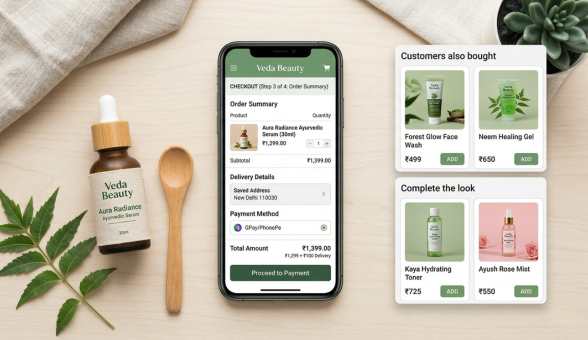
Cross-selling placements in an online store typically appear in three spots: on the product detail page under a section like “Frequently bought together,” on the cart page as a last-minute suggestion before checkout, and on the order confirmation page as a post-purchase prompt for their next visit.
Indian buyers are generally receptive to bundle suggestions if they represent clear value. “Buy both for Rs. 799 instead of Rs. 950” or “Add this for just Rs. 149 more” are messaging formats that consistently perform well in Indian markets because they frame the cross-sell as a saving rather than an extra expense.
Want to See How Boomimart Handles Product Bundling and Checkout Upsells?
Upsell vs Cross-Sell: A Quick Comparison
Before going into implementation, it helps to see both tactics side by side so you can plan which one suits each product category in your store.
| Aspect | Upselling | Cross-Selling |
| Goal | Move customer to higher-value item | Add related items to the cart |
| Placement | Product page, cart review | Product page, cart, order confirmation |
| Example | 500ml pack vs 1L pack | Phone case suggested with a phone |
| AOV Impact | Higher single item value | More items per order |
| Best For | Electronics, food, wellness | Fashion, home decor, accessories |
How to Build a Product Bundling Strategy That Actually Sells
Bundling is one of the most effective ways to deploy cross-selling at scale in an Indian online store. Instead of showing recommendations dynamically on a per-visit basis, you pre-create curated bundles that make obvious sense to the buyer and display them as their own product listings.
The first step is to analyse your order data. Look at which products are most frequently purchased together. If 30 percent of customers who buy your bestselling face wash also add a toner within the same session, those two items belong in a bundle. If buyers who purchase a pooja thali frequently add an agarbatti box, that is your bundle right there.
Once you identify natural product pairings from real buyer behaviour, you can set bundle pricing that gives a small discount, say 8 to 12 percent off the combined individual price. This discount needs to be visible and framed clearly. Indian consumers are deal-conscious, and if the savings are not visible at a glance, the bundle will not attract the attention it deserves.
The bundle should also have a compelling name. Rather than “Product A + Product B,” use something like “Daily Glow Duo” or “Home Office Starter Pack” that suggests a use case and makes the combination feel intentional rather than arbitrary.
Pricing Your Bundles for the Indian Market
Indian buyers compare prices carefully. A bundle that does not show at least a 7 to 10 percent saving over purchasing items separately rarely converts better than individual product pages. At the same time, if your margins are tight, you do not need to discount deeply. You can also bundle a slow-moving item with a bestseller to improve its visibility and clearance, effectively giving the customer a “bonus” without cutting into your core margins.
Consider also offering free shipping as the bundle benefit rather than a price discount. Given that many Indian platforms charge Rs. 40 to 80 for shipping on smaller orders, “free delivery with this bundle” can feel more compelling than a 5 percent price drop.
Where to Place Upsell and Cross-Sell Prompts in Your Store
Placement is as important as the offer itself. A great upsell shown at the wrong moment in the shopping journey will be ignored. Here is how to think about placement at each stage of the funnel.
On the Product Detail Page
This is the highest-intent page on your store. The buyer has found what they want and is evaluating whether to buy. This is the right place for an upsell, shown just below the add-to-cart button, something like “Customers who bought this also chose the larger pack.” Keep it to one or two options, not a carousel of ten. Too many choices create decision fatigue and push the customer away from buying altogether.
On the Cart Page
The cart page is where the customer has already decided to buy. They are in a committing mindset. Cross-sells perform better here than upsells because the buyer has already chosen their item and a complementary addition feels natural rather than replacive. A simple “You might also need” section with one or two items at a lower price point than the cart total tends to convert well.
At the Order Confirmation Stage
This placement is underused by most Indian sellers. After a successful payment, the buyer is in a positive emotional state. A post-purchase upsell that says “Add this to your order before it ships, no extra shipping cost” can drive 5 to 15 percent additional revenue depending on the category. This works especially well for consumable products where the customer knows they will need more soon.
Want to See How Boomimart Handles Product Bundling and Checkout Upsells?
Which Techniques Work Best by Product Category?
Not every tactic fits every product type. This overview helps you prioritise based on your catalogue.
| Product Category | Best Tactic | Example Offer |
| Fashion and Apparel | Cross-sell | “Complete the outfit” add-ons |
| Food and Grocery | Upsell + Bundle | Family pack or subscription upgrade |
| Electronics and Gadgets | Upsell | Higher storage or newer model |
| Beauty and Skincare | Bundle | Routine kit with 3-product set |
| Home Decor and Furniture | Cross-sell | Matching cushions or lamps with sofa |
Writing Recommendation Copy That Converts Indian Buyers
The words you use around your upsell or cross-sell suggestion matter significantly. Indian buyers are savvy and quick to dismiss anything that feels like a sales script. The copy needs to feel helpful and specific to the product context.
Avoid generic phrases like “You may also like” without context. Instead, try something more grounded: “Most buyers of this pack also pick up the matching travel pouch” or “Over 1,200 customers bought these two together last month.” Social proof and specificity make the recommendation feel curated rather than automated.
When writing for Hindi-speaking or regionally oriented audiences, consider whether a bilingual label like “Saath mein lo” (meaning “take it together”) alongside the English recommendation improves relatability. This small adjustment can make a meaningful difference in tier-2 and tier-3 city markets where regional comfort increases conversion.
Research from the Baymard Institute on product page UX consistently shows that contextual, use-case-based recommendation copy outperforms generic labels by a wide margin. The principle holds true across geographies, and Indian e-commerce is no exception.
Using Data to Refine Your Upsell and Cross-Sell Strategy Over Time
The first version of your bundling and recommendation strategy should be based on your best guess backed by order history. But over time, you need actual performance data to tell you what is working and what is not.
Track these metrics for each upsell or cross-sell placement: click-through rate on the recommendation, add-to-cart rate from the recommendation, conversion rate of orders that include the recommended item, and AOV difference between orders with and without recommendations accepted.
If a cross-sell is getting clicks but not adds-to-cart, the product pairing makes sense to buyers but the price point or offer framing is off. If a bundle is getting views but no purchases, the discount may not be compelling enough or the bundle name is not communicating the value clearly enough.
Running monthly reviews of these numbers and making incremental adjustments is how growing Indian D2C brands separate themselves from stores that stay flat. You can also explore the Boomimart pricing page to understand how different plans support analytics, bundling, and product recommendation features.
Common Mistakes to Avoid When Setting Up Upsells and Cross-Sells
Many sellers deploy these tactics but see poor results because of avoidable execution errors. Here are the most common ones and how to sidestep them.
| Mistake | Why It Hurts | What to Do Instead |
| Showing too many options | Creates decision fatigue | Limit to 2-3 curated suggestions |
| Irrelevant pairings | Feels like random selling | Use real purchase data to pair products |
| No price incentive on bundles | Buyers see no reason to bundle | Show savings clearly in rupees |
| Placing upsell after payment | Feels intrusive and late | Use post-purchase cross-sell instead |
Subscription Upgrades as a Long-Term Upsell Strategy
For brands selling consumable products, one of the most powerful upsells available is not a bigger pack but a subscription. Inviting a customer to switch from a one-time purchase to a recurring delivery with a modest discount, say 10 to 15 percent off, converts a single transaction into predictable monthly revenue.
This works well for wellness supplements, personal care products, pet food, cleaning supplies, and coffee or tea. The customer saves money, you gain revenue visibility and reduced customer acquisition costs over time because the same buyer keeps returning automatically.
Setting up a subscription model on your Indian D2C store has become significantly more accessible in recent years. Platforms like Boomimart offer built-in tools for recurring billing and order management that make this a viable option even for brands at an early growth stage.
When presenting the subscription upsell, frame it around the customer’s benefit: “Never run out, save every month, cancel anytime.” That last phrase, cancel anytime, is particularly important for Indian buyers who tend to be cautious about commitments they perceive as difficult to exit.
Making Every Order Work Harder for Your Business
Growing revenue in Indian e-commerce does not always require more traffic. Sometimes the most efficient path to higher returns is simply making better use of the buyers already on your store. Upselling and cross-selling, when implemented thoughtfully and tested consistently, can add 15 to 30 percent to your AOV without increasing your marketing spend by a single rupee.
Start with one technique, whether that is a simple bundle on your top two products or a cart page cross-sell for your bestseller, measure the results over four to six weeks, and then expand from there. Small, deliberate steps compound into significant revenue gains over a full selling season.