How to Sell Books and Educational Materials Online in India

India’s appetite for books and learning content has never been more varied. Students preparing for NEET and JEE, working professionals upskilling through certification guides, parents sourcing Montessori activity kits, and literature readers hunting for regional language fiction are all online and actively spending. For publishers, authors, tutors, and small educational businesses, this is an enormous market that is still largely fragmented and underserved.
Selling books and educational materials online in India is no longer complicated if you know what to set up, how to handle the category-specific challenges, and which platform to use. This guide walks you through the full picture, from catalogue structure to delivery, with practical steps you can act on immediately. Whether you plan to sell physical books, digital downloads, or both, the right setup on a platform like Boomimart will give you the control and flexibility this category demands.
Understanding the Book and Educational Material Market in India
The Indian books and educational content market spans several distinct buyer segments, each with its own purchasing behaviour. Academic buyers, primarily students and their parents, tend to purchase in short seasonal windows around board exams, entrance exam cycles, and the start of school terms. This creates predictable demand spikes from February to May and again in September to November.
Non-academic buyers, including fiction readers, self-help enthusiasts, and professional development seekers, purchase more evenly throughout the year and are increasingly comfortable buying from independent stores and author-run websites rather than only from Amazon or Flipkart.
A third and growing segment consists of educators, coaching institutes, and edtech creators who sell their own study material, workbooks, and printed notes directly to students. This segment overlaps heavily with digital downloads and is one of the fastest-growing categories for independent online stores in India today.
Understanding which segment you serve determines how you structure your catalogue, your pricing, and your logistics. A store selling JEE preparation guides has very different seasonal dynamics and customer expectations compared to a store selling regional language novels or a coaching centre selling printed test papers. This distinction matters from day one of setting up your store. You can explore how Boomimart supports catalogue-rich stores at boomimart.com/d2c-ecommerce.
Setting Up Your Book Store: What Your Product Catalogue Needs
Books have specific metadata requirements that most general e-commerce stores overlook but that directly impact searchability and buyer confidence. Every product listing for a physical book should include the author name, publisher, edition year, number of pages, language, subject or genre, and ISBN if available. Buyers of academic books in particular will search by these attributes, not just by title.
For educational workbooks or study kits, include board (CBSE, ICSE, state board), class or grade level, subject, and whether the material covers the full syllabus or a specific chapter range. Buyers searching for “Class 10 CBSE Maths guide 2026” expect to find exactly that, and stores that structure their listings with this specificity consistently outperform those with vague titles.
Physical Books vs Digital Downloads: Setting Up Both
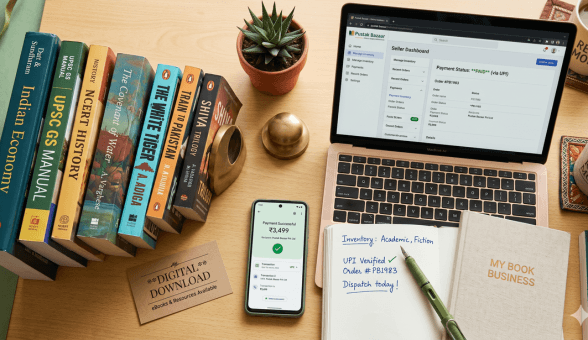
Physical books require standard inventory management, but digital downloads need a different setup. For PDFs, e-books, audio lectures, or printable worksheets, your store must handle secure file delivery after payment confirmation. The buyer should receive a download link automatically, with a time or attempt limit to prevent casual redistribution.
Digital products also have a different return policy consideration. Because the file is delivered instantly and cannot be “returned” in the traditional sense, your store policy should clarify that digital purchases are non-refundable except in the case of a defective or incorrect file. Communicating this clearly on the product page builds trust rather than anxiety. The Boomimart digital download and product catalog setup supports both physical and digital product types with appropriate delivery and policy handling for each.
Want to Launch Your Book or Educational Store Online?
Pricing Books Online: What Works in the Indian Market
Book pricing in India follows a different logic from most product categories. Buyers are accustomed to seeing an MRP printed on the cover and frequently search for discounted prices below that MRP. For new books, a discount of 10 to 20 percent off MRP is standard and expected on any credible online store. Offering full MRP prices positions your store as less competitive than even a neighbourhood bookshop.
For educational materials you create yourself, such as a tutoring centre selling its own notes, there is no MRP benchmark and you have more flexibility. Price based on the value delivered: the cost of printing or producing the content, the specificity of the material to a particular exam or syllabus, and what similar study resources sell for in your market.
Digital downloads can be priced at a meaningful discount versus physical versions since there are no printing or shipping costs. A physical guidebook priced at Rs. 450 might be offered digitally for Rs. 199, making it accessible to students in smaller cities where delivery timelines are longer and where parents prefer immediate access.
Pricing Benchmarks by Book Type
| Book Type | Typical Price Range | Discount Strategy |
| School textbooks (CBSE/ICSE) | Rs. 150 to Rs. 600 | 10 to 15% off MRP |
| Competitive exam guides | Rs. 300 to Rs. 900 | 15 to 20% off MRP |
| Fiction and literature | Rs. 199 to Rs. 599 | 10% off, bundle deals |
| Self-published digital notes | Rs. 99 to Rs. 499 | No MRP, value-based pricing |
| Printed coaching material | Rs. 250 to Rs. 1,200 | Batch or set discounts |
Handling Shipping and Delivery for Books
Books are one of the more forgiving physical products to ship. They are not fragile, do not spoil, and rarely require special packaging beyond a bubble wrap envelope or kraft paper wrap for hardcovers. However, weight and size do matter for shipping costs, and getting this right reduces margin erosion on lower-priced titles.
For single-book orders below Rs. 300, flat-rate shipping tends to eat into your margin if you use premium couriers. Consider setting a free shipping threshold, such as orders above Rs. 499, which also encourages buyers to add a second title. A free shipping nudge at the cart page, showing the buyer how close they are to qualifying, works particularly well in the books category because the impulse to add one more title is natural.
For institutional buyers such as schools, libraries, or coaching centres placing bulk orders, offer a separate pricing enquiry or a bulk order form. These buyers often want 10 to 100 copies of the same title, and handling this through a standard single-unit checkout is cumbersome for both parties.
Regional Language Titles and Delivery to Tier-2 and Tier-3 Cities
If your catalogue includes regional language books, such as Tamil, Telugu, Kannada, Marathi, or Bengali titles, your shipping reach to non-metro cities becomes especially important. Readers of regional language content are largely located outside of the four major metros, and delivery timelines to those pin codes need to be reliable.
Work with courier partners that have solid coverage across these geographies, and be transparent on the product page about estimated delivery windows for different regions. A buyer in Madurai or Vijayawada ordering a Tamil or Telugu novel has fewer local store options and a higher dependence on your delivery promise. Getting this right builds repeat business. You can read more about shipping management for Indian SMB e-commerce stores to understand courier selection and COD management for wider coverage.
Want to Launch Your Book or Educational Store Online?
Physical Books vs Digital Downloads: A Comparison for Indian Sellers
Many sellers wonder whether to focus on physical books, digital downloads, or both. The answer depends on your catalogue and buyer segment, but here is a clear overview to help you decide.
| Factor | Physical Books | Digital Downloads |
| Inventory needed | Yes, upfront stock required | No, file delivered on demand |
| Shipping required | Yes, adds cost and time | No, instant delivery |
| Margin per unit | Lower after shipping and print | Higher, near-zero fulfilment cost |
| Returns handling | Standard returns process | Non-refundable policy typical |
| Best for | Textbooks, fiction, gifting | Notes, worksheets, guides, e-books |
SEO and Product Discovery for Your Book Store
Books have natural SEO advantages because buyers search with high specificity. Someone looking for a book will often type the exact title, author name, board, class, and edition. Your product pages need to be built to capture these long-tail searches.
Use the full book title in your page title and H1 heading. Include the author name, publisher, and edition year in the product description body, not just in a metadata field. Add a short paragraph describing what the book covers, who it is best suited for, and what makes this edition or version worth buying. This content serves both the reader and the search engine.
For your category pages, use subject and grade-level based headings rather than generic labels. A category page called “Class 12 CBSE Science Books” will rank for far more relevant searches than a page labelled simply “School Books.”
If you are new to writing product content that ranks and converts simultaneously, the guide on product descriptions that rank on Google and convert buyers is a practical resource that applies directly to books and educational content.
Building Trust With Buyers: What Educational Material Sellers Often Miss
Books and educational materials carry a trust requirement that goes beyond what most product categories demand. A parent buying a Class 9 science guide is making a decision that affects their child’s studies. A student purchasing notes for a competitive exam is spending money they take seriously. Your store needs to communicate credibility from the first impression.
Display edition years and syllabus alignment prominently. If a guide covers the latest NCERT syllabus or the updated NTA exam pattern, say so explicitly on the product page and in the title. If you are selling your own coaching notes, include a brief bio or credential line for the author, whether that is your qualification, years of teaching experience, or the number of students you have trained.
Customer reviews carry particular weight in this category. A short review from a student who cleared their board exam using your notes, or a parent who found the activity kit helpful for a child with learning differences, builds trust faster than any product description you can write. Build a habit of requesting reviews from buyers 10 to 14 days after delivery, which gives them time to use the material and form a genuine opinion.
What to Sell: Popular Subcategories for Indian Online Book Stores
Not all books have the same demand curve or margin profile. Here is a quick overview of the most commercially viable subcategories for Indian sellers entering this space.
| Subcategory | Demand Pattern | Margin Potential |
| CBSE and ICSE textbooks | Strong April to July, Oct to Nov | Low to medium, high volume |
| Competitive exam prep (NEET/JEE/UPSC) | Year-round, peaks Jan to April | Medium, high repeat purchase |
| Regional language fiction | Steady year-round | Medium, niche audience loyalty |
| Children’s activity books | Peaks in summer vacation months | Medium to high |
| Self-published educational notes | Varies by exam cycle | High, no print cost for digital |
| Professional certifications (CA/CMA) | Year-round, exam-linked spikes | Medium to high |
Selling Your Own Educational Content as a Tutor or Creator
One of the highest-margin opportunities in this space is for educators who create their own study material and sell it directly to students through their own store. If you run a coaching centre, teach a subject independently, or have developed a proprietary method for preparing students for a specific exam, your notes, worksheets, and guides are a product with genuine market value.
The advantage here is that no one else can replicate what you sell. Your Class 10 Maths shortcuts with your own teaching style, or your IELTS preparation kit based on your methodology, carries your identity as its differentiator. This means you do not compete on price with Amazon or Flipkart. You compete on specificity and trust, which is a far more comfortable position.
Sell printed versions for students who prefer physical material and digital PDF versions for those who want immediate access. Offer a combo option where the buyer gets both for a modest premium over the individual digital price. This simple bundle logic tends to perform well with parents who buy for their children and want the flexibility of print for home study and digital for travel.
For growing educational content businesses, tools like content marketing through a store blog can also drive consistent organic traffic. The approach outlined in this guide on content marketing for e-commerce applies directly to educational stores where expertise-based content builds credibility and search visibility simultaneously.
Want to Launch Your Book or Educational Store Online?
Managing Seasonal Demand Without Overstocking
The academic books category is one of the most seasonally concentrated niches in Indian e-commerce. A large portion of annual sales happens across a 10 to 12 week window before board exams and at the start of new school terms in June. Planning your inventory for this cycle is critical to avoiding two equally costly problems: running out of fast-moving titles at peak demand, or sitting on excess stock that does not sell once the season passes.
Order initial stock conservatively and track sell-through rates weekly during the peak window. Reorder titles that sell out within the first two weeks of the season rather than trying to forecast the exact volume upfront. For digital products, this problem does not exist as there is no physical stock to manage.
After the academic season, shift your promotional energy to summer activity books, holiday reading lists, and general interest titles. Buyers who purchased from you in February for board prep can be re-engaged in May for summer reads through email or WhatsApp follow-up, building year-round revenue from a customer base that would otherwise go quiet for eight months.
Building a Store That Readers and Learners Come Back To
The Indian books and educational material market rewards specificity, trust, and consistency. Buyers in this space are not impulse purchasers in the way that fashion or snack shoppers often are. They research, compare, and return to stores that delivered on their promise before. A store that ships the right edition on time, presents clear product information, and handles a query about a mismatched syllabus edition professionally will earn a customer who comes back every academic year.
Starting with a focused catalogue, a well-structured product listing format, and reliable delivery fundamentals gives you the foundation to grow into broader categories and larger volumes. Explore the Boomimart pricing page to find a plan that fits where your book or educational content business is today, with room to scale as your catalogue and customer base grow.