Coupon and Discount Strategy for E-commerce: When to Discount and When to Hold

Every Indian online seller has felt the same pull at some point. Sales are slow, competitors are running offers, and the easiest thing to do feels like dropping the price. Put a 20 percent off banner on the homepage and watch orders come in. The problem is not that discounting does not work. It works very well. The problem is that it works in the short term in ways that can quietly undermine the long term, and most sellers only notice the damage after the habit has taken root.
The discipline behind coupon and discount strategy is not about avoiding discounts. It is about knowing precisely when they create value, for which customer, at what depth, and with what guardrails in place. A discount offered at the right moment to the right buyer on the right product advances your business. The same discount offered habitually, site-wide, to everyone, trains your buyers that your prices are negotiable and your brand has no confident sense of its own value.
This guide covers the full decision framework for Indian e-commerce sellers: the types of discounts available, the situations that call for each, how to calculate a safe discount floor, the patterns that destroy margins and brand equity, and how to build a promotions calendar that drives revenue without eroding the pricing foundation your store depends on. If you are managing pricing and promotions on Boomimart, the coupon and discount configuration tools let you set all of these guardrails directly in your admin panel.
The Discount Dilemma: Why the Easy Answer Is Often the Wrong One
A discount solves a visible problem immediately. Low conversion rate, slow-moving stock, a quiet week before payday, a competitor’s sale causing buyers to stall. The price drop addresses the symptom and the order count ticks up. What does not show up in the same dashboard view is the margin compression, the buyer behaviour shift, or the gradual erosion of your product’s perceived value.
The single most expensive discounting mistake Indian e-commerce sellers make is training buyers to wait. Once a segment of your customer base learns that your store runs offers regularly, they stop purchasing between promotions. They bookmark your product, wait for the next sale, and buy at a discount that was meant to be an occasional incentive, not a permanent alternative price. According to research cited across e-commerce strategy studies, 62 percent of shoppers delay clothing purchases until a discount is offered when they have seen a brand discount frequently in the past. That behaviour, once formed, is extremely difficult to reverse without a deliberate repricing and repositioning strategy.
The answer is not to avoid discounts. It is to use them with specific intent, defined scope, and clear measurement so that each promotional campaign advances a business goal rather than simply responding to anxiety about slow sales.
Six Situations Where Discounting Creates Genuine Value
Not all discount occasions are equal. These are the situations where a well-structured offer generates real business benefit that justifies the margin cost.
1. Acquiring a First-Time Buyer
A new customer discount has a different economics from a repeat-customer discount. The first purchase from a new buyer costs you something in marketing spend whether or not you offer a discount. A modest welcome offer, 10 percent off or free shipping on the first order, lowers the barrier to a trial without permanently devaluing the product because the buyer has no existing price anchor for your brand. The key constraint is that the first-time discount must be genuinely first-time: tied to a new account, a new email address, or a referral code, not available site-wide to all buyers including existing customers. Research on Indian online shopping behaviour consistently shows that 29 percent of online buyers in India search for a discount code before completing a purchase, which means a visible first-purchase offer captures a meaningful share of conversion-ready new visitors.
2. Clearing Slow-Moving or Seasonal Inventory
Inventory that is not turning generates carrying costs, occupies storage space, and ties up working capital. A targeted clearance discount on specific slow-moving SKUs is an inventory management decision, not a brand decision. The critical discipline here is product specificity: the discount applies to defined SKUs, not to the entire catalog. Site-wide clearance sales train all buyers to expect lower prices on everything. SKU-specific clearance signals to buyers that these particular items are on offer while the rest of the catalog retains its full-price positioning.
3. Recovering Abandoned Carts
A buyer who has added your product to cart and left without purchasing has already demonstrated intent. They are not a cold lead. A triggered coupon sent via WhatsApp or email within 2 to 4 hours of abandonment, offering a modest incentive to complete the order, recovers a sale that would otherwise have been lost entirely. This discount creates net-new revenue because the alternative is zero revenue from that interaction, not full-price revenue. Keep abandonment recovery discounts at 5 to 10 percent or a free shipping offer. Deep discounts for cart recovery signal to buyers that they should always abandon cart first and wait for an offer.
4. Driving Festival or Seasonal Sales Windows
Indian festivals create genuine commercial moments where discounting is contextually expected and does not damage brand perception because every seller participates. A Diwali offer, a Holi sale, or an end-of-financial-year clearance in March happens within a defined window and against a specific occasion. Buyers understand the time-bound nature of these offers and do not use them as a reference point for everyday pricing. The discipline is to maintain clear start and end dates, communicate the occasion-specific reason for the offer, and return to full pricing immediately when the window closes.
5. Rewarding Loyal Repeat Buyers
A loyalty discount for your most frequent buyers is a retention investment, not a margin sacrifice. A buyer who has made three or more purchases is several times more likely to make a fourth than a first-time buyer is to make a second. An exclusive discount offered to this segment, framed as a reward for their loyalty rather than a general sale, strengthens the relationship without broadcasting the offer to price-sensitive one-time buyers. The exclusivity of the offer is what makes it valuable: a loyalty coupon code that works for all buyers immediately loses its relational meaning.
6. Moving Excess Stock Before a Catalog Refresh
When you are bringing in new product collections or upgrading to newer models, existing stock needs to move. A structured end-of-range offer at a defined discount depth, with clear communication that these are outgoing items, moves the inventory without creating the impression that the brand is generally discounting. Buyers understand clearance sales for outgoing inventory as a practical business reality rather than as a signal that your products are overpriced.
When to Hold the Price: Five Situations Where Discounting Hurts
Knowing when not to discount is as important as knowing when to apply one. These are the situations where holding the price protects something more valuable than the immediate order.
When Sales Are Slow Because of Discovery Problems
If your store is not generating traffic, discounting does not solve the underlying problem. You are offering a lower price to the same small audience rather than reaching more buyers. The discount costs you margin on every order from existing visitors without increasing the pool of potential buyers. A slow store needs better SEO, better paid traffic strategy, better content, or better product-market fit, not a price cut.
When a Competitor Discounts and You Feel Pressure to Match
Reactive discounting in response to competitor promotions is one of the most reliable paths to a margin race that benefits nobody except the buyer. If your product has genuine quality or service differentiation, communicate that differentiation rather than matching the competitor’s price. Buyers who are choosing between you and a competitor solely on price are not the buyers who build loyal repeat-purchase relationships anyway.
When Your Hero Products Are Involved
Your best-selling, highest-margin flagship products should almost never be the centre of a discount campaign. They sell at full price because buyers recognise their value. Discounting them for a short-term sales spike teaches your best buyers that waiting is worthwhile, and it sets a new psychological price anchor that makes future full-price purchases feel more expensive than they did before the sale.
When You Have Not Calculated Your Floor
A discount applied without knowing your margin floor is a guess that may be profitable or may not be. Before any promotional campaign, calculate the minimum price at which the discounted order still delivers your target gross margin after accounting for product cost, packaging, fulfilment, payment gateway fees, and any additional promotional costs. Running a campaign at a price below your floor is not a sale. It is a subsidy paid to your buyers.
When It Has Become the Default Response
If your team reaches for the discount lever every time a weekly target looks soft, the discount has stopped being a strategic tool and has become a crutch. Regularly discounting without a specific business reason trains both your buyers and your team to treat full price as the exception rather than the standard.
Discount Types and When to Use Each
Not all discounts are structurally equal. The type of discount you offer shapes how buyers perceive it and what behaviour it drives.
| Discount Type | Best Use Case | Risk to Avoid |
| Percentage off (e.g. 15% off) | First purchase, seasonal sales, festivals | Avoid site-wide on hero products |
| Fixed rupee off (e.g. Rs. 100 off) | Minimum spend threshold offers | Cap applies, set floor carefully |
| Free shipping coupon | Cart abandonment, first purchase | Viable only if margins support it |
| Buy X Get Y (BOGO) | Consumables, fashion multipacks | Only for compatible product pairs |
| Tiered volume discount | Replenishment products, B2B orders | Track margin per tier, not just revenue |
Percentage discounts feel larger to buyers at higher price points, making them effective for festival sales and category-wide events. Fixed rupee discounts work better with minimum spend requirements, where a Rs. 150 off on orders above Rs. 999 lifts the average order value while capping the actual discount cost regardless of what the buyer spends. Free shipping, while technically not a price reduction, consistently outperforms equivalent rupee discounts in conversion impact because Indian buyers respond strongly to the absence of visible shipping charges at checkout.
Want to Manage Discounts and Margins From One Dashboard?
Calculating Your Discount Floor: The One Number You Must Know
Every discount campaign should start with the same question: what is the lowest price at which this order is still profitable for me? That number is your floor. Any discount that takes the order below the floor is a loss, and running a promotional campaign at a loss is a choice that should be made deliberately, not by accident.
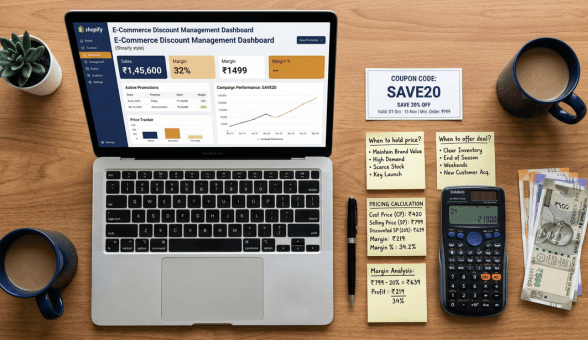
The floor calculation for a simple product order works as follows. Take the product cost. Add packaging cost, fulfilment cost, and payment gateway fee. Add a proportional share of your monthly operating overhead allocated per order. The result is your total cost per order. Your floor price is the selling price at which your gross margin target is just met. For most Indian SMB e-commerce stores, a minimum gross margin of 30 to 35 percent per order is a sustainable target. Any discount that takes the margin below that floor should require explicit approval as a strategic decision, not happen as a default setting.
| Cost Component | Typical Range for Indian SMB Seller |
| Product cost (COGS) | 40 to 55% of selling price |
| Packaging and materials | 2 to 5% of selling price |
| Fulfilment and shipping | 5 to 12% of selling price |
| Payment gateway fee | 1.5 to 2.5% of selling price |
| Minimum target gross margin | 30 to 35% of selling price |
| Maximum safe discount depth | Selling price minus (COGS + packaging + fulfilment + gateway + floor margin) |
Running this calculation for each product category tells you precisely how aggressive your discounts can be. A fashion item with a 60 percent margin can safely accommodate a 20 percent discount. A food staple with a 25 percent margin may not be able to sustain even a 10 percent discount without going below your floor. Knowing these numbers per category before your promotion calendar is designed prevents margin surprises after the campaign closes.
Want to Manage Discounts and Margins From One Dashboard?
Building a Promotions Calendar: Structuring Discounts Across the Year
A promotions calendar converts discounting from a reactive habit into a planned strategy. When you know in advance which periods will have promotions, which discount types will apply, and what the business objective of each campaign is, you can prepare inventory, set floor prices, configure coupon rules, and measure outcomes against defined goals.
The Indian e-commerce calendar offers roughly 8 to 10 major promotional windows annually. The sellers who drive the highest festival revenue are consistently those who began preparation 4 to 6 weeks before the occasion, not those who offered the deepest discounts. The discipline of planning prevents the panic discounting that happens when a festival approaches and the store has no campaign ready.
Structure Each Promotional Window With Three Parameters
- Business objective: Acquisition, retention, inventory clearance, or AOV lift. The discount type and depth follows from the objective.
- Target segment: All buyers, first-time buyers, loyalty segment, or cart abandoners. Broad campaigns cost more margin per order than targeted ones.
- Guardrails: Maximum discount depth, minimum order value, usage limit per customer, campaign end date. Every promotion needs defined constraints to prevent runaway cost.
With these three parameters defined for each campaign, you can configure your coupon rules with confidence and measure whether the campaign achieved its objective after it closes.
The Healthy Promotions Frequency Rule
A practical guideline for Indian e-commerce stores is to run planned promotional campaigns for no more than 25 to 30 percent of the calendar year. The remaining 70 to 75 percent of the year should operate at full price with no active site-wide discounting. This ratio preserves the contrast between promotional and non-promotional periods that gives discounts their motivating power. A store that is always on sale trains buyers that the sale price is the real price, which eliminates the urgency that makes promotional campaigns convert.
Coupon Code Best Practices: Configuration and Control
The technical configuration of your coupon codes determines how much control you have over the financial outcomes of your promotional campaigns. A coupon without guardrails can be shared beyond its intended audience, stacked with other offers in unintended ways, or used by existing customers when it was meant only for new ones.
Usage Limits Per Customer
Every coupon should have a per-customer usage limit. A first-purchase welcome code with no usage limit can be used repeatedly by the same buyer, turning a new-customer acquisition tool into a permanent discount for one customer. Set usage limits at one or two per customer for acquisition campaigns and three to five for loyalty campaigns where repeat use is intentional.
Minimum Order Value Requirements
Attaching a minimum order value to discount codes lifts average order value while protecting margins on low-value orders. A coupon offering Rs. 100 off orders above Rs. 699 costs you Rs. 100 only on orders where the buyer has already committed to spending Rs. 699, making the effective discount percentage more manageable than a flat Rs. 100 off any order value.
Product and Category Restrictions
Configure your coupons to exclude high-margin hero products or already-discounted items whenever possible. A site-wide coupon that also applies to items already on sale creates double-discount situations that can push specific orders below your margin floor. Boomimart’s coupon configuration allows product-level, category-level, and collection-level restrictions so you have full control over which items a code applies to.
Preventing Coupon Stacking
Two active coupons applied to the same order can produce combined discounts that nobody planned for. Configure your coupon rules so that only one discount applies per order, with a clear priority rule determining which code takes precedence when multiple codes are valid. Flash sales and automatic discounts should block manual coupon codes during their active window to prevent unintended combinations.
Alternatives to Discounting That Protect Your Margin
The goal of a promotional campaign is to motivate a purchase. Price reduction is one mechanism for achieving that goal, but it is not the only one, and in many situations it is not the most effective one. These alternatives create purchase motivation without cutting into your margin.
Free Shipping as the First Incentive
For Indian e-commerce buyers, visible shipping costs at checkout are one of the most common reasons for abandonment. Offering free shipping on orders above a defined threshold, set just above your current average order value, motivates buyers to add items to reach the threshold while costing you only the shipping subsidy rather than a percentage of the product margin. The psychological impact of eliminating a charge is often stronger than the equivalent rupee discount.
Gift With Purchase
Including a small branded gift or a sample-size complementary product with orders above a certain value creates perceived value without reducing the price. A beauty brand that adds a travel-size product to orders above Rs. 999 is offering a tangible benefit at the cost of a product that has a low manufacturing cost but high perceived value. The buyer feels rewarded without receiving a price reduction that creates a new price anchor.
Early Access and Exclusivity
For loyal customers, offering early access to a new product launch, a limited collection, or a sale before it opens to the general public creates a sense of privilege that is more powerful for brand building than a discount. The buyer’s reward is access and recognition, not a price reduction. This approach strengthens the buyer-brand relationship in ways that a coupon code cannot replicate.
Loyalty Points and Store Credit
A loyalty programme that awards points on every purchase, redeemable for future orders, keeps buyers engaged between purchase cycles without requiring you to discount at the point of sale. The buyer’s incentive to return is built into every transaction, and the redemption of points creates a purchase occasion rather than discounting a purchase that would have happened anyway. Boomimart’s platform features include customer account management that supports loyalty and repeat purchase mechanics for growing stores.
Measuring Whether Your Discounts Are Working
A promotional campaign that drives order volume but damages long-term profitability is not a successful campaign. Measuring discount performance requires looking beyond the revenue spike during the promotion window to the metrics that indicate whether the campaign advanced your business goals.
| Metric | What It Tells You |
| Discount redemption rate | What share of exposed buyers used the code |
| Campaign gross margin | Whether the campaign was profitable after costs |
| New vs returning buyer split | Whether acquisition codes are reaching new buyers |
| Post-campaign full-price conversion | Whether buyers return at full price after the promotion |
| Average order value during vs outside promotion | Whether the promotion lifted basket size or just converted at lower price |
The most important signal is the post-campaign full-price conversion rate. If buyers who purchased during a promotion return to buy at full price in the following 60 days, the promotion acquired or retained a genuinely valuable customer. If the same buyers only ever purchase during promotional windows, the promotion is subsidising discount-motivated buyers who contribute lower lifetime value than full-price buyers at higher short-term margin cost.
Track these metrics for every promotional campaign and review the cumulative trend quarterly. The goal is to see discount-period orders contributing to a growing base of full-price repeat buyers, not a growing base of buyers who only respond to offers. That trajectory is the sign of a healthy promotional strategy rather than a margin-eroding habit.
Frequently Asked Questions
How deep should a first-purchase welcome discount be?
For most Indian e-commerce categories, a first-purchase discount of 8 to 12 percent or a free shipping offer is sufficient to convert a hesitant new buyer without setting an aggressively low price anchor. Discounts above 20 percent on a first order attract highly price-sensitive buyers who are unlikely to return at full price and may train the buyer to perceive your regular pricing as inflated.
Can I run a discount on my best-selling products during Diwali?
Yes, with specific constraints. A festival discount on hero products should be time-bound with a clear end date, capped at 10 to 15 percent to protect the price anchor, and framed explicitly as a festival offer rather than a markdown. Return to full pricing immediately after the festival window closes and communicate that return clearly. Buyers who purchased during the festival understand that the occasion justified the price; they do not carry the discounted price as a new baseline if the return to full pricing is consistent and immediate.
What is coupon stacking and why is it a problem?
Coupon stacking occurs when a buyer applies two or more discount codes to the same order, combining discounts in ways the seller did not intend. A buyer who applies a 15 percent welcome code on top of a 10 percent festival discount on an already-marked-down item may end up with a combined discount that takes the order well below the margin floor. Preventing stacking through platform-level configuration is essential before running multiple concurrent promotions.
How do I discount without training buyers to wait for sales?
The key is unpredictability and specificity. Random, occasion-specific, or segment-specific discounts that buyers cannot anticipate do not train waiting behaviour because there is no reliable pattern to wait for. A Diwali sale happens every year, so buyers will factor it in. But a surprise loyalty offer sent to customers who have not purchased in 45 days, or an exclusive new-collection preview for your top buyers, cannot be anticipated and does not train general discount-waiting behaviour.
What is the difference between a coupon and a discount in Indian e-commerce?
A coupon is a buyer-initiated offer: the buyer must enter a code to receive the benefit. A discount is seller-applied: it appears automatically on the product page or cart without any action from the buyer. Coupons give you tracking data on how each code was discovered and used. Discounts apply more broadly and are typically used for sale periods, volume pricing, or category-wide promotions. Both are valid tools; the choice between them depends on whether you want to track acquisition channels and control redemption, or create a broadly visible reduced-price offer.
How often should I audit my promotions strategy?
A quarterly review of your overall discount strategy is the minimum. Each quarter, compare your promotional period revenue against non-promotional revenue, review your gross margin trend across all orders, check the post-promotion full-price return rate, and assess whether any buyer segments are exclusively promotional buyers. An annual review of your full promotions calendar lets you plan the following year’s occasions with data from the current year, progressively improving your discount depth and timing decisions based on observed buyer behaviour rather than assumptions.