Warehouse Management for E-commerce: From Home Storage to Fulfilment Centre

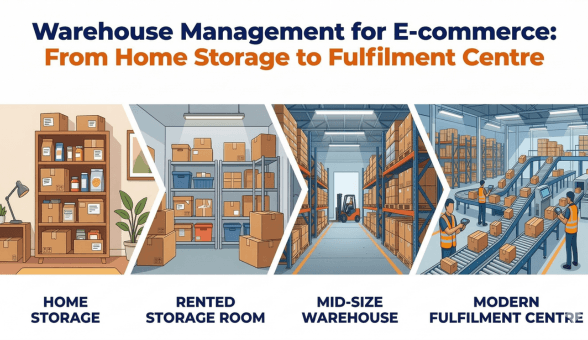
Most Indian e-commerce founders start the same way. A corner of the bedroom becomes the stockroom. Bubble wrap lives on the dining table. Orders are packed between meals, and shipping labels are printed on a consumer inkjet. It works at 20 orders a month.
It stops working at 200.
The journey from that first bedroom shelf to a proper fulfilment centre is one of the most underestimated operational challenges in Indian e-commerce. Every stage of that journey introduces new problems: lost stock, delayed shipments, wrong items going out, cash locked in unsold inventory, and a team that spends more time firefighting than fulfilling.
Why Warehouse Management Matters More Than Most Sellers Realise
Warehouse management is not just about where you store products. It determines how fast orders ship, how often mistakes happen, how much working capital is tied up in stock, and whether a customer who ordered today gets the right item on the right day.
For Indian e-commerce businesses, the stakes are higher than in many other markets because:
- COD (cash on delivery) still accounts for a large share of orders in Tier 2 and Tier 3 cities, meaning returns are more frequent and inventory management becomes critical to cash flow
- Indian courier SLAs are tied to when a consignment is handed over, not when an order is placed, so internal fulfilment speed directly determines delivery dates
- Festive season spikes (Diwali, Pongal, Eid) can multiply order volumes 5x to 10x overnight, overwhelming any warehouse setup that was not designed to scale
Managing 100+ Orders a Month? See How Boomimart Inventory Works - Book a Free Demo
Stage 1: Home Storage (0 to 100 Orders per Month)
What this stage looks like
Most Indian D2C founders start here. Stock is stored at home, usually in a spare room, a designated corner, or repurposed cupboards. Packing is done manually. There is no formal picking process. The founder handles everything from order review to dispatch.
What works at this stage
- Low overhead with no rent or staffing costs
- Fast, personal quality control on every package
- Direct feedback loop between packaging observations and product decisions
What breaks at this stage
- Stock gets mixed up, especially for products with multiple variants (size, colour, weight)
- No formal bin or location system means picking time increases as stock grows
- Order records kept in notebooks or spreadsheets become error-prone above 30 to 40 daily orders
- There is no separation between business stock and personal space, which creates family friction and compliance issues
What to put in place before moving to Stage 2
Even at this stage, the habits you build determine how painlessly you scale. Three things matter most:
- Label every product with a SKU code and store items by SKU, not by feel
- Record every order in a centralised system, not a notebook or WhatsApp message
- Set a minimum reorder quantity for each SKU and track stock levels daily
| Storage Stage | Order Range | Main Risk |
| Home / Bedroom | 0 to 100 orders/month | Variant mix-ups and no stock visibility |
| Rented Storage | 100 to 500 orders/month | Manual processes break under volume |
| Managed Warehouse | 500 to 3,000 orders/month | Coordination between store and warehouse |
| Fulfilment Centre / 3PL | 3,000+ orders/month | Integration and cost per unit management |
Stage 2: Rented Storage Room or Small Godown (100 to 500 Orders per Month)
What triggers this move
You outgrow your home storage when one or more of these things happen: your home cannot hold enough stock to cover a full week of orders without restocking, packing is taking more than four hours a day, your family is frustrated, or you are consistently shipping wrong variants.
What this stage looks like
A rented room, shop shed, or small godown in your city. Typically 200 to 500 square feet. You or a part-time packer handles fulfilment. Stock is organised on basic metal shelving. Courier pickup happens once or twice a day.
Operational changes needed at this stage
- Create a physical bin location system: assign each SKU a specific shelf and position, labeled with printed signs
- Introduce a picking list process: print or display a list of items per order before packing begins
- Hire a part-time packing assistant if daily orders exceed 40 to 50
- Maintain a receiving log for every inbound shipment from suppliers
Common mistakes at this stage
The most expensive mistake Indian sellers make at this stage is continuing to manage stock in Excel or Google Sheets. At 200 orders a month, the volume of updates required makes spreadsheet errors inevitable. A single wrong stock count can lead to overselling, which damages customer trust and triggers negative reviews.
Managing 100+ Orders a Month? See How Boomimart Inventory Works - Book a Free Demo
Stage 3: Managed Warehouse with a Small Team (500 to 3,000 Orders per Month)
What this stage looks like
You now have a dedicated warehouse space, typically 1,000 to 5,000 square feet, with a small operations team of two to six people. There is a defined receiving area, a storage zone, a packing station, and a dispatch area. Daily courier pickups are scheduled. You are processing 20 to 100 orders per day consistently.
Key operational requirements at this stage
Stock Receiving and Putaway
Every inbound shipment from suppliers must be counted, checked against purchase orders, and recorded in the system before stock is put on shelves. Skipping this step is how ghost inventory appears: stock that the system thinks exists but physically does not.
Pick and Pack Process Design
At this stage, a structured pick-and-pack process prevents the most common fulfilment errors. The two most effective approaches for Indian SMB warehouses are:
- Single-order picking: one packer picks and packs one order at a time. Simple to manage and easy to audit. Suitable up to about 150 orders per day.
- Batch picking: a picker collects items for 10 to 20 orders simultaneously using a consolidated pick list, then a separate packer assembles individual orders. Faster above 150 daily orders but requires more coordination.
Packaging Standardisation
Standardising packaging materials (box sizes, tape, dunnage) at this stage saves significant time and cost. When every packer makes their own packaging choices, you get inconsistent weights, dimensional weight billing surprises from couriers, and damaged-in-transit claims.
Shipping Label and Invoice Automation
| Process | Manual Approach | Boomimart Automated Approach |
| Stock Receiving | Counted and entered manually into spreadsheet | Scanned and updated in real time |
| Order Picking | Handwritten list or printed from email | Auto-generated pick list from dashboard |
| Label Generation | Typed or copy-pasted per order | Bulk generated with one click |
| Return Processing | Excel entry and manual restocking | Return logged, stock updated automatically |
What breaks at this stage without the right systems
- Phantom inventory: system shows 50 units available but physical count shows 30, leading to overselling
- Label mistakes: wrong shipping label on a box, sending Customer A’s order to Customer B’s address
- Packing station bottlenecks: one slow step (like printing invoices one at a time) holds up the entire dispatch
- No visibility into courier performance: you cannot see which carrier is causing the most delays or damage until customer complaints pile up
Stage 4: Third-Party Logistics (3PL) and Fulfilment Centres (3,000+ Orders per Month)
What this stage means for Indian sellers
At 3,000 or more monthly orders, managing your own warehouse becomes a full business unit in itself. You need a warehouse manager, shift workers, security, packing infrastructure, and a WMS (warehouse management system). Many Indian D2C brands at this stage choose to outsource warehousing entirely to a 3PL (third-party logistics) provider.
How 3PL works in India
You send bulk inventory to the 3PL’s fulfilment centre. When an order comes in on your store, it flows automatically to the 3PL, which picks, packs, and ships the item directly to your customer. You never touch the physical order.
Major 3PL options in the Indian market include Delhivery Fulfillment, Shiprocket Fulfillment, Pickrr (now Shiprocket), and Ezycom. Regional players in specific states offer lower costs for businesses that sell primarily within one or two states.
What to look for in a 3PL partner
- SLA for same-day or next-day dispatch based on order cut-off times
- Real-time stock visibility through API integration with your store
- Return handling process and restocking accuracy rates
- Dimensional weight billing practices and packaging standardisation
- Geographic reach of their courier network relative to your customer base
3PL integration with your e-commerce store
Managing 100+ Orders a Month? See How Boomimart Inventory Works - Book a Free Demo
Inventory Management Principles That Apply at Every Stage
Regardless of whether you are in a bedroom or a 10,000 square foot facility, the same inventory management principles drive results.
ABC Analysis
Classify your products into three groups based on sales contribution. A-class products (top 10 to 20 percent of SKUs driving 70 to 80 percent of revenue) should have dedicated, easily accessible storage positions and tighter reorder monitoring. B and C class products can occupy secondary positions. This classification should be reviewed monthly because seasonal trends shift which SKUs are A-class.
FIFO (First In, First Out)
For any product with a shelf life (food, cosmetics, medicines, organic products) or with packaging that can show aging (printed boxes), always dispatch older stock first. This sounds obvious but without a deliberate storage layout that physically forces FIFO, it does not happen consistently.
Safety Stock Calculation
Safety stock is the buffer inventory you hold above your expected demand to cover demand spikes and supplier delays. A simple formula for Indian e-commerce:
For a product that sells an average of 10 units per day (max 18 units) and has an average supplier lead time of 7 days (max 12 days), safety stock would be (18 x 12) minus (10 x 7) = 216 minus 70 = 146 units.
Dead Stock Identification
Stock that has not moved in 90 days is dead stock. It locks up working capital and takes up space that active SKUs need. Review slow-moving stock monthly and take one of three actions: discount it aggressively in a clearance sale, bundle it with fast-moving products, or write it off and donate or dispose of it.
| Inventory Concept | What It Prevents |
| ABC Analysis | Stockouts on best-sellers, over-investment in slow movers |
| FIFO Storage Layout | Expired or aged stock being dispatched to customers |
| Safety Stock Buffer | Stockouts during demand spikes or supplier delays |
| Dead Stock Review | Working capital locked in unsellable inventory |
Warehouse Technology: What Tools Are Worth the Investment
For Stage 1 and Stage 2 sellers
The only non-negotiable technology investment is a proper e-commerce platform with built-in inventory management. Everything else can be manual at this stage. A spreadsheet is not a substitute because it does not update in real time as orders are placed.
For Stage 3 sellers
A barcode scanner and label printer are worth the investment once you cross 50 daily orders. Scanning items during picking eliminates the most common error type (picking the wrong SKU variant) and speeds up receiving significantly.
For Stage 4 sellers
At fulfilment centre scale, a dedicated WMS (warehouse management system) becomes essential. However, the WMS must integrate with your e-commerce platform. A disconnected WMS creates a second data silo that requires manual synchronisation, which defeats its purpose.
Shipping Integration and Last-Mile Management
Warehouse management does not end when an order leaves your packing station. Last-mile delivery is where customer experience is made or broken, and Indian sellers have more complexity here than in most markets.
Multi-carrier strategy
Relying on a single courier is a common and costly mistake. Different Indian couriers perform differently by region, product type, and weight band. Delhivery, Bluedart, Ekart, DTDC, and Xpressbees each have geographic strengths and weaknesses.
A multi-carrier strategy with automatic carrier assignment based on destination pincode and shipment weight gives you the best combination of delivery speed and cost. This requires your e-commerce platform to support multi-carrier shipping rules, which Boomimart handles natively.
Building Your Warehouse Team
Operations technology only works if the people using it follow the processes it supports. Warehouse teams in Indian SMBs are often hired quickly during growth spurts and trained inadequately, which is why errors spike when order volumes increase.
Key roles at each stage
| Stage | Key Hire | Primary Responsibility |
| Stage 1 (Home) | Founder only | All operations |
| Stage 2 (Storage Room) | Part-time packer | Picking, packing, dispatch |
| Stage 3 (Warehouse) | Operations Manager | Process adherence, team coordination, inventory accuracy |
| Stage 4 (3PL / FC) | Vendor Manager | SLA monitoring, integration, escalation |
Training focus areas
The two most impactful training areas for Indian warehouse teams are SKU identification accuracy and receiving process discipline. SKU errors during picking are the primary cause of wrong-item dispatch. Receiving errors (not checking inbound counts against purchase orders) are the primary cause of phantom inventory.
A 30-minute induction covering these two areas, with a written SOP displayed at both the packing station and the receiving area, reduces warehouse error rates by 40 to 60 percent in the first month.
Managing 100+ Orders a Month? See How Boomimart Inventory Works - Book a Free Demo
Connecting Warehouse Operations to Your E-commerce Dashboard
The gap between what is happening in your physical warehouse and what your e-commerce system believes is happening is where most operational problems originate. Every manual step between a physical event (a product picked up, a return received, a shipment scanned) and a digital record creates an opportunity for error.
Every stage of warehouse growth is manageable if you build the right habits and systems at the right time. The businesses that struggle are not those with the smallest warehouses. They are the ones that waited too long to replace manual processes with systems designed for their actual order volume.