
Size Guide and Fit Charts: Why This Simple Page Reduces Returns by 40%

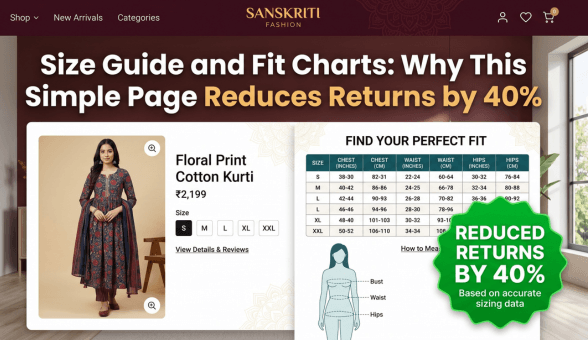
Returns are the silent margin killer of Indian fashion e-commerce. A sale that looks like revenue on day one becomes a cost by day seven when the product comes back because it did not fit. The return shipment, the re-inspection, the restocking, the refund processing, and the lost customer: every wrong-size return carries a cost that most Indian apparel sellers significantly underestimate.
The most common reason for returns in Indian fashion e-commerce is not product quality. It is sizing. A buyer ordered a medium and received a medium, but the medium did not fit the way they expected. This is not a fulfilment error. It is an information gap that existed before the order was placed, and it is one that a well-built size guide eliminates almost entirely.
The Scale of the Sizing Problem in Indian Fashion E-commerce
Return rates in the Indian fashion and apparel category sit between 25 and 40 percent for most online sellers, significantly higher than other product categories. Among buyers who return clothing, wrong size or poor fit is cited as the primary reason in the majority of cases across market research conducted on Indian e-commerce behaviour.
This number is not a fixed cost of doing business in fashion. It is a variable that is directly responsive to the quality of sizing information you provide before the purchase is made. Sellers who invest in accurate, easy-to-use size guides consistently see return rates drop into the 15 to 20 percent range for size-related returns, with some D2C brands achieving even lower rates when size guides are combined with fit photography and measurement tutorials.
Why Indian Sizing Is Especially Confusing for Online Buyers
Indian apparel sizing has no single universal standard. A medium from one brand fits like a large from another. The Indian size numbering system (38, 40, 42 for chest measurements) runs alongside XS, S, M, L, XL, XXL, alongside free-size claims that cover body measurement ranges so wide as to be meaningless. Regional tailoring traditions mean that a kurta designed with a Lucknow fit has different proportions from one designed with a South Indian fit, even at the same labeled size.
For Indian online buyers, ordering a garment involves a calculation that many find genuinely stressful: translating their body measurements into a brand-specific size label without being able to physically try the garment. Buyers who cannot make this calculation with confidence either do not purchase (lost sale) or purchase and return when the fit is wrong (lost margin). A size guide removes the calculation uncertainty entirely.
What a Complete Size Guide Actually Looks Like
Most Indian apparel sellers who do have a size guide on their store have something that looks like a size guide but does not function as one. A table with S, M, L, XL in the header row and generic chest measurements underneath is not a size guide. It is a size label reference that still requires the buyer to guess whether their measurements match your garment measurements.
A size guide that actually reduces returns has four components, all working together.
Component 1: Garment Measurements, Not Just Body Measurements
The most common mistake in Indian e-commerce size charts is listing only body measurements: “Medium: chest 36 to 38 inches”. This tells the buyer what body size the garment is designed for, but it does not tell them how the garment itself will fit.
Listing both gives buyers the full picture. They can see that a garment with a half-chest of 21 inches gives 42 inches of chest circumference total, and decide whether that is the fit they want for the silhouette shown in the product image. This level of detail is what separates size guides that buyers actually use from ones they scroll past.
Component 2: How to Measure Instructions
Many Indian buyers, particularly first-time online shoppers and buyers in Tier 2 and Tier 3 markets, do not know how to take accurate body measurements. A size guide that assumes measurement literacy will produce incorrect measurements even when buyers try to use it correctly.
A brief, illustrated guide showing where on the body each measurement is taken, and how to hold the tape measure, turns your size guide from a reference tool into a buying assistant. This can be as simple as a line-drawn illustration of a figure with arrows indicating measurement points, accompanied by two-line instructions for each measurement.
- Chest: Measure around the fullest part of the chest, keeping the tape parallel to the floor
- Waist: Measure around the natural waist, which is the narrowest point of the torso, typically about 2 to 3 cm above the navel
- Hip: Measure around the fullest part of the hips, typically 18 to 20 cm below the natural waist
- Length: Measure from the top of the shoulder (where the seam sits) straight down to the desired hemline
Component 3: Fit Type Information
The same body measurements can result in a very different experience depending on the cut and fit of the garment. An Indian kurta described as “straight cut” will fit differently from one described as “A-line” even at identical chest and length measurements. A slim-fit shirt for a 40-inch chest will feel tighter than a regular-fit shirt with the same chest measurement because the slim fit has less ease built in at the waist and hips.
Including a brief fit description alongside the measurements prevents mismatches between what the buyer imagines and what they receive. Even a simple one-line note like “This kurta is designed with a relaxed fit. If you prefer a fitted silhouette, consider sizing down” provides the context that turns a potential size-related return into a confident purchase.
Component 4: Model and Product Photography Reference
Every product image with a model should include the model’s height and the size they are wearing in the image caption or product description. “Model is 5’6″ and wearing size Medium” gives buyers a visual anchor for how the garment will look on a body of similar proportions. This is one of the highest-conversion additions to any fashion product page and requires no additional photography investment.
Want to Build Product Pages That Convert and Reduce Returns?
Building Size Charts for Different Indian Apparel Categories
Different garment types need different measurement dimensions. A single generic size chart applied across all products is less useful than category-specific charts that capture the measurements that matter for each type of clothing.
Kurtis, Kurtas, and Ethnic Tops
The measurements that matter most for Indian ethnic tops are chest, length from shoulder to hem, and sleeve length for full-sleeve designs. Hip measurement becomes relevant for A-line and flared kurtas where the hip and hem width affects whether the garment hangs well on the buyer’s frame.
| Size | Chest (inches) | Length (inches) |
| Small (S) | 36 to 38 | 44 to 46 |
| Medium (M) | 38 to 40 | 45 to 47 |
| Large (L) | 40 to 42 | 46 to 48 |
| XL | 42 to 44 | 47 to 49 |
Note that the above is an illustrative format. Your actual measurements should be taken from the physical garments you stock, not from industry averages. Garment measurements vary between manufacturers and between fabric types, so a size chart copied from a competitor or from a generic source will not accurately represent your specific products.
Sarees and Dupattas
Sarees are one garment category where sizing anxiety is lower because sarees are draped rather than fitted, and a standard 5.5 to 6.5 metre saree accommodates a wide range of body sizes. However, blouse sizing is a significant source of confusion and returns. Indian blouse sizing follows chest measurement in inches, but blouse cut (short-sleeve vs full-sleeve, boat neck vs round neck, back type) adds complexity.
For sarees sold with a blouse piece, specifying the blouse piece dimensions (width and length of the unstitched fabric) helps buyers assess whether it can be stitched to their measurements by their local tailor.
Men’s Ethnic Wear and Western Wear
Indian men’s kurta sizing uses chest measurement in inches as the primary label, with 38, 40, 42, 44 being the most common sizes. Men’s western wear (shirts, trousers) typically uses a combination of chest and collar size, or waist and inseam for trousers.
The critical addition for men’s Indian wear is shoulder width. Indian men’s body proportions vary significantly by region, and a garment that fits a buyer from North India in the chest may have a shoulder seam that falls off the shoulder for a buyer from South India with the same chest measurement but narrower shoulders. Including shoulder width in the measurement chart for men’s ethnic wear addresses one of the most common fit complaints in this category.
Children’s Clothing
Children’s apparel size guides should always include age range, height range, and weight range alongside standard measurements. Parents buying online for children use all three as reference points, and a size chart that provides only one of these three dimensions leaves too much uncertainty. For babies and toddlers, age and weight are the primary references. For older children, height becomes the most reliable guide.
Where to Place the Size Guide on Your Product Page
A size guide that exists but cannot be found does not reduce returns. Placement and visibility determine whether buyers use the information you provide.
Placement Options That Work
- Directly below the size selector: A clickable “Size Guide” link or a collapsible accordion panel immediately below the S/M/L/XL selector is where buyers look for sizing help at the moment they are making their size decision. This is the highest-visibility placement.
- Persistent sticky element on mobile: On mobile screens, where most Indian online fashion purchases happen, a persistent “Measure & Find Your Size” button that opens a bottom sheet with the size guide keeps the information accessible without taking up permanent screen space.
- Within the product description: Including key measurements inline within the product description, such as “This kurta measures 21 inches half-chest (42 inches total) at size Medium and 46 inches in length”, gives measurement context to buyers who read descriptions rather than looking for a size chart.
- A dedicated Size Guide page linked from the header or footer: A universal size guide page that covers all categories in your store, accessible from the main navigation, helps buyers who come to your store wanting to understand your sizing before selecting individual products.
What Reduces Size Guide Usage
- Placing the size guide link in a small text footnote at the bottom of a long product description where it is unlikely to be noticed
- Opening size guide information in a new browser tab that disrupts the purchase flow on mobile
- Using a size guide image that is too small to read on a mobile screen without zooming
- Requiring the buyer to navigate away from the product page to a separate size guide page, breaking the checkout momentum
Size Guide Language for the Indian Market
How you write the size guide matters as much as what measurements it contains. Indian buyers come from a wide range of educational backgrounds and regional clothing traditions, and a size guide written with the assumption that all buyers understand western sizing conventions will lose a significant portion of your audience.
Use Indian Size References Where Possible
Many Indian buyers are more familiar with Indian size numbering (38, 40, 42 for chest) than with XS, S, M, L, XL labels. For ethnic wear specifically, offering both labeling systems in the same chart reduces confusion. “Medium / Size 40” in the same cell is more helpful than either label alone.
Write Measurement Instructions in Plain Language
Measurement instructions should be written as if explaining to someone who has never used a measuring tape for clothing before. Avoid technical terms like “ease” (the extra space built into a garment beyond body measurements for comfort and movement) without explaining what they mean. If you mention ease, explain it: “We add 2 inches of ease to the chest measurement for comfortable movement, so a garment with a half-chest of 21 inches will feel comfortable on a 40-inch chest rather than tight.”
Address Common Indian Sizing Concerns Directly
Indian buyers frequently have specific concerns that a generic size guide does not address:
- Dupatta length: For ethnic sets sold with a dupatta, the dupatta length and width matter to buyers for draping style. Include these dimensions.
- Salwar or churidar dimensions: For sets that include a bottom garment, buyers need the waist measurement range (often elasticated), the length, and whether the bottom tapers (churidar style) or is straight.
- Embroidery and embellishment placement: Buyers want to know if embroidery is positioned at the chest, border, or hem so they can assess whether it will fall in the right place on their body.
Want to Build Product Pages That Convert and Reduce Returns?
The Connection Between Size Guides and Return Policy Confidence
There is a reinforcing relationship between a well-built size guide and buyer confidence in purchasing at full price. Buyers who are uncertain about sizing often wait for a sale event because the lower price feels like insurance against getting the fit wrong. If the garment does not fit, at least they did not pay full price.
Measuring the Impact of Your Size Guide
Adding a size guide is an investment of time and effort. Measuring its impact tells you whether that investment is working and where to improve it.
Metrics to Track Before and After
| Metric | How to Measure | Expected Improvement |
| Return rate (size-related) | Track return reason in your returns log | 20 to 40 percent reduction in size returns |
| Size guide page / element views | Analytics events on size guide clicks | Indicator of buyer engagement with sizing info |
| Conversion rate by product | Compare conversion before and after adding guide | 5 to 15 percent lift for products with detailed guides |
Tracking Size Guide Engagement
If your e-commerce platform supports event tracking, set up a click event on the size guide link or accordion. This tells you what percentage of product page visitors are engaging with the sizing information. A high engagement rate with a low return rate confirms the size guide is working. A high engagement rate with a still-high return rate suggests the guide is being consulted but may be inaccurate or unclear in its presentation.
Using Return Reason Data to Improve Your Size Guide
Every return that comes back with a size or fit reason should be reviewed against your size guide. If buyers consistently return a specific product saying “too long” or “shoulder too wide” despite consulting the size guide, the guide may have inaccurate measurements for that product or the garment may have changed in a supplier production run without the measurements being updated.
Size Guides for Non-Apparel Fashion Categories
The size guide principle extends beyond clothing to several other Indian e-commerce fashion categories where fit and dimension uncertainty drives return rates.
Footwear
Indian footwear sizing is inconsistent across brands, and the gap between Indian, UK, US, and European sizing systems confuses buyers who purchase international or internationally-designed footwear from Indian sellers. A footwear size guide should include the Indian size number, the equivalent international sizes, and most importantly, the insole length in centimetres. Buyers who know their foot length in centimetres can match it directly to the insole measurement and are significantly less likely to order the wrong size.
Jewellery and Accessories
Ring sizing is one of the most common sources of jewellery returns. A ring size guide that includes both the Indian ring size number and the inner diameter of the ring in millimetres, combined with instructions on how to measure finger circumference using a strip of paper, reduces ring returns substantially. For bangles and bracelets, inner diameter in centimetres alongside the standard 2.2, 2.4, 2.6, 2.8 size coding gives buyers the information they need.
Home Textiles
For bed linen, curtains, and table linen, buyers need to know the actual finished dimensions of the product to match it to their furniture and space. A single-bed sheet that fits one brand’s “single bed” may not fit another, because single beds in India range from 30×72 to 36×72 inches. Specifying actual product dimensions in centimetres eliminates this category of return almost entirely.